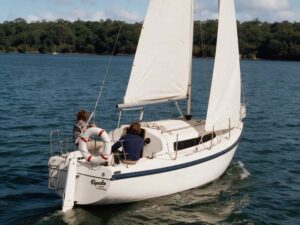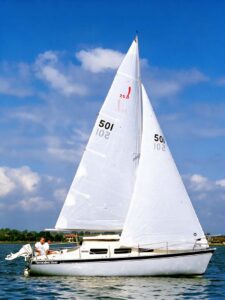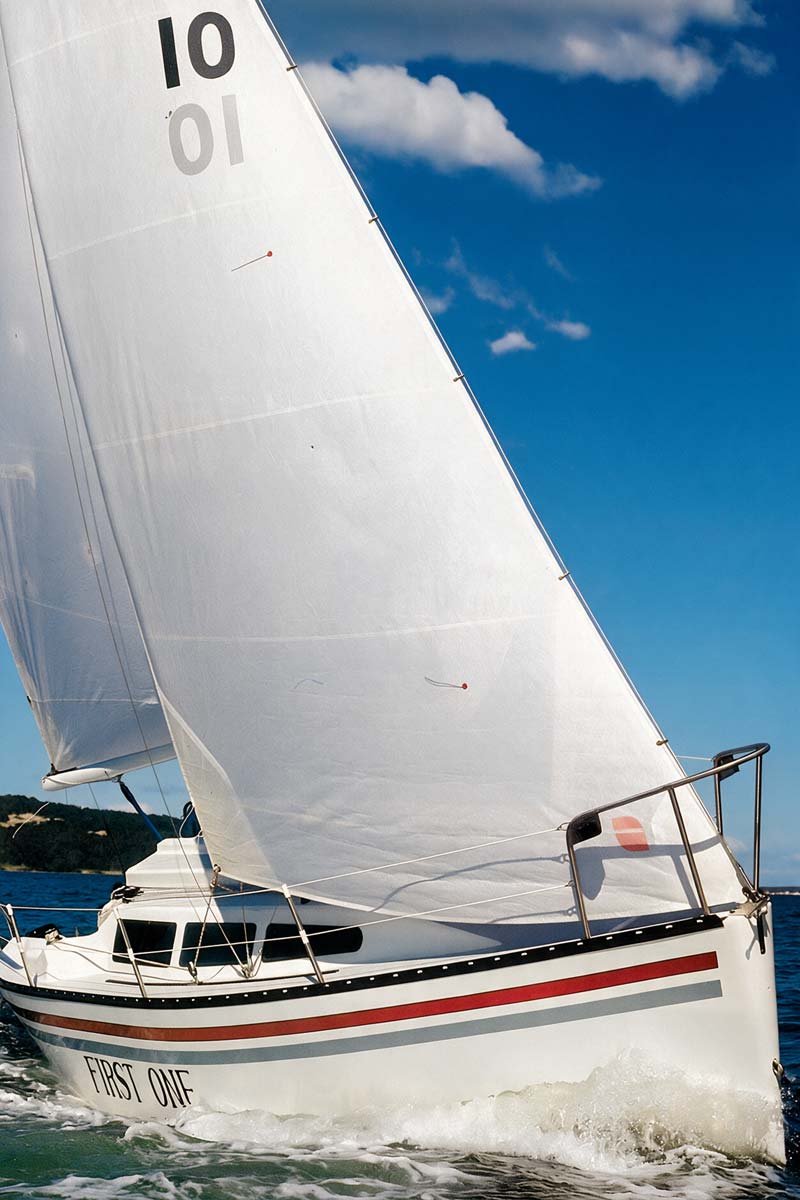
Keeping up with updates to the Sonata yacht range had always been a moving target, following a line of evolutions from the Sonata 7 (formerly the Southern Cross 23) to various length modifications like the 6, 8, 6.3, and 26. Seeking a completely new look rather than another minor update, John Porter of Pacific Sailboat Centre commissioned Kevin Brown of KB Fibreglass to build an expanded version of the popular Mull-designed Sonata 6.7. This new design elongated the 6.7 hull into a 7.8-meter vessel with 30 cm higher freeboard, a 90 cm longer coachhouse, and a redesigned interior.
Achieving these new dimensions required a laborious modification process. Because the hull was already at the maximum legal trailering width of 2.5 meters, Brown and employee Stephan Stackman spent six gruelling weeks cutting, adjusting, and fairing the original hull, cabin, pop-top, and transom. Economic downturns eventually led Porter to pull out of the project, prompting Brown to invest $150,000 and 18 months of work to complete the plug, mould, and prototype independently. Choosing a name proved equally tricky, moving through various musical and indigenous-sounding ideas before settling on “Kalaroo,” loosely translated as “path to the water.”
Visually, the boat presents a somewhat slab-sided profile from behind with a narrow transom, though its bow quarters offer a much more attractive line. The aesthetic compromises were accepted intentionally to maximize internal volume, yielding a remarkably spacious cabin for a boat under 26 feet. Inside, the lack of a fixed dinette opens up floor area, providing head room just under 1.78 meters with the pop-top down. The layout accommodates up to five people with two single quarter berths, a port settee, and a vee berth. It features a longitudinally mounted drop-leaf table seating four, an L-shaped galley with a two-burner stove and plastic sink, and a enclosed toilet tucked between the bulkhead and forward berth.
Construction consists of a 12mm Divinycell foam core hand-laid with vinyl ester resin, complemented by a 10mm foam deck and solid glass reinforcements around chainplate anchorages. The vessel weighs approximately 900 kg unladen, but with its 400 kg keel ballast, rig, and trailer, the total towing weight sits around 1,700 kg, requiring a capable four-wheel-drive or V8 tow vehicle. Rigging uses a whippy Prolgreane mast section adapted from skiff designs, supported by single spreaders, lower check stays, and a powerful backstay. The mast pivots on a pin, allowing single-handed raising, while the lead keel lowers to a 1.65m draft via a hydraulic system and locks in place.
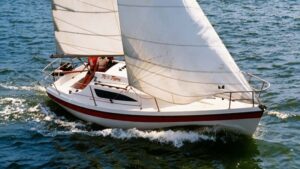
Under sail, the Kalaroo 780 delivers impressive speed and stability despite its upright, utilitarian appearance. Driven by sailmaker Bob Russell’s efficient sail plan, the hull tracks high to windward and handles lively conditions smoothly. The heavy 400kg bulb keel counteracts the generous sail area effectively, allowing the crew to stay comfortable inside the cockpit without needing to hike out on the coaming. Minor handling quirks include slight weather helm and a tendency for the narrow stern to sink slightly under weight, dragging the outboard bracket and rudder casing. Overall, for its price point, the boat offers exceptional volume, strong build quality, and surprisingly brisk performance for a cruising trailer sailer (Rothfield 1990, pp. 64-69).
SPECIFICATIONS:
* LOA: 7.80m
* LWL: 6.80m
* Beam: 2.50m
* Draft (board down): 0.45m / 1.65m
* Displacement: 1300kg
* Towing Weight: 1700kg
* Ballast: 400kg
* Sail Area (Main): 20.5 sq m
* Sail Area (No. 1): 16.9 sq m
* Sail Area (No. 2): 13.5 sq m
* Sail Area (No. 3): 9.8 sq m
* Price (Lock-up only): $25,000 (1990) (includes hull and deck joined, hydraulics, keel, toe rails, furniture, windows, hatches, and bulkheads fitted)
* Price (As tested): $40,000
* Builder: KB Fibreglass
Source: Rothfield, Mark ‘Kalaroo 780’ Modern Boating, 1990, November, pp. 64-69.
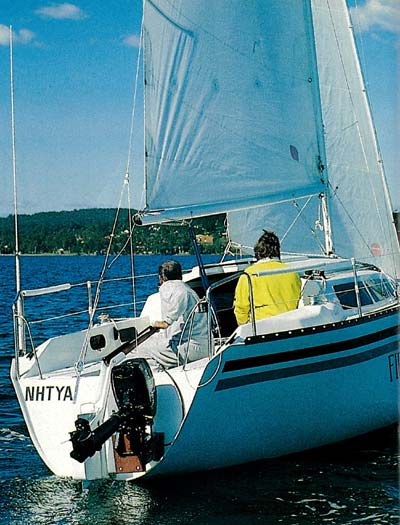
Historical photograph reproduced for identification and historical research purposes. Copyright remains with the original rights holder.
Quick tip: Keep in mind that trailer sailers can vary quite a bit, even within the same class. Take the RL28, for example: they might not all have outboard wells as designed. Some originally may have had inboard engines, and when those were removed, the owners swapped them for a standard outboard mounted on the stern.