Bruce Roberts has spent a remarkably long time creating straightforward and accessible boat designs intended for amateur builders. Although he currently manages his extensive plan and kit business from the West Coast of the United States, he maintains a strong presence in Australia, where his yacht design career originally began. In Australia, Roberts is represented by Andy Slorach, who oversees the Bruce Roberts International boat building park situated in Queensland. At this location, amateur builders have the option to construct a vessel completely from scratch, or they can streamline the building process by purchasing one of Roberts’ ready-made hull and deck kits.
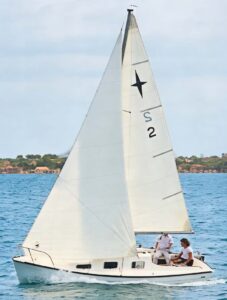
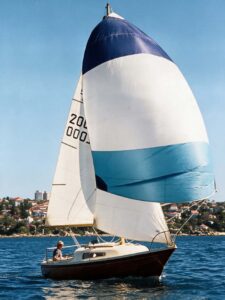
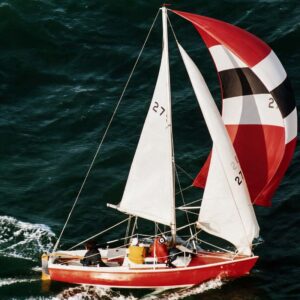
The latest addition to the off-the-shelf kit line-up available at the Australian Roberts park is the Vegas 21. Rather than being designed directly by Bruce Roberts himself, this new craft was designed by Len Freestone to complement the existing hull and deck offerings. Considering the ever-increasing expense of boat building, the Vegas 21 is strategically designed to offer a budget-friendly, entry-level option for boaters. Serving as a trailer-sailer, it can function either as a trailer-yacht or as a permanently moored vessel. When kept on a mooring, its combination of a retractable centreboard and a shallow mini-keel makes it particularly well suited for shallow-water anchorages.
While the design features somewhat conservative styling, the Vegas 21 appears well-suited to the boating demands of the 1980s. Its shallow hull shape is expected to perform well under sail while offering the essential stability required for safe inshore cruising. Although it is not built as a high-speed racing craft, it could potentially compete effectively in club handicap racing if equipped with appropriately optimized rigging and sails.
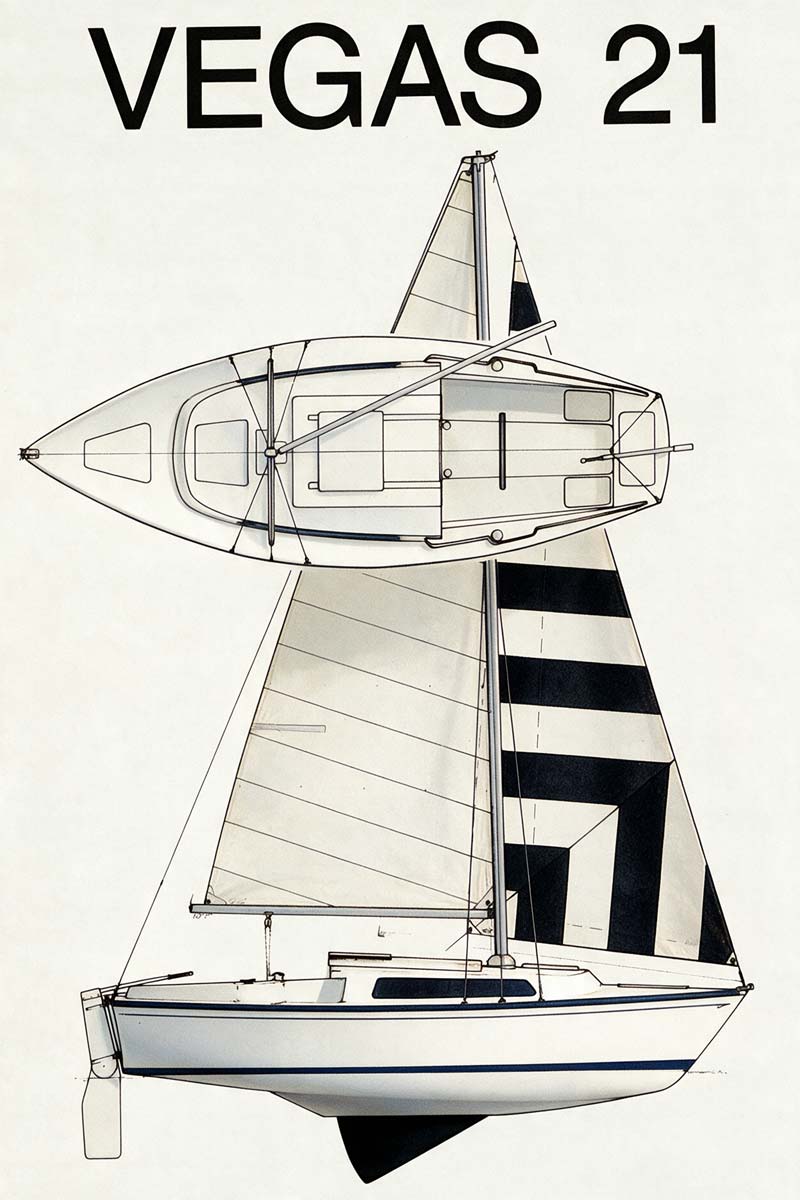
Inside the vessel, the layout utilizes a tried-and-tested arrangement of fore and aft bench berths. This configuration provides sleeping space for four people positioned head-to-head, and it can be converted into a double berth in the bow area when needed. While interior space is naturally constrained for a boat of this scale, the designers positioned the centrecase so that it does not encroach on the cabin space as heavily as seen in alternative centreboard craft.
Because the primary objective of a design like this is to minimize total costs, the designer understandably kept the vessel simple and basic. Nevertheless, within these budget limitations, the design incorporates most features expected in a modern small yacht or trailer-sailer. These features include a pop-top hatch, a foredeck anchor well, a self-draining cockpit, and three cockpit storage hatches to supplement the storage space provided under the bunks.
No specific mounting provision is built in for an outboard motor, but owners should be able to easily mount one to the transom using a standard adjustable lift bracket purchased from a local chandlery. Overall, the Vegas 21 should appeal to budget-conscious sailing enthusiasts who desire an affordable vessel capable of overnight cruising. The hull and deck shell can be bought ex-factory for $5,650 (1987), which represents excellent value. With additional investment and effort, a builder could reasonably expect to get this six-metre sailboat fully rigged and operational for under $10,000, which is less than half the cost of a comparable ready-made sailboat.
Specifications:
– Length: 6.42 m
– LWL : 5.38 m
– Beam: 2.34 m
– Draft: 40–107 cm
– Displacement: 1015 kg
– Ballast: 250 kg
– Sail Area – Mainsail: 10.4 m²
– Sail Area – Genoa: 13.75 m²
– Sail Area – No. 2 Jib: 9.1 m²
Source: ‘Vegas 21’ Australian Boating, 1987, November, p. 28.
Historical photograph reproduced for identification and historical research purposes. Copyright remains with the original rights holder.
Quick tip: Keep in mind that trailer sailers can vary quite a bit, even within the same class. Take the RL28, for example: they might not all have outboard wells as designed. Some originally may have had inboard engines, and when those were removed, the owners swapped them for a standard outboard mounted on the stern.