Despite having a proven track record overseas, unstayed cat-rigged boats have struggled to gain popularity in Australia. In the late 1970s, innovative American designer Garry Hoyt introduced his unstayed Freedom 40 concept. Following this, several Australian naval architects, including Ben Lexcen with his Revolution 38 and Jon Swarbrick with a trailer sailer called Alien, dabbled with unstayed rigs, though these designs remain rare on local waters today. Meanwhile, Hoyt continued to refine his concepts, finding success across America and Europe with a range of cat-style craft. While his earliest designs drew heavily on windsurfer concepts like flexible masts, envelope sails, and wishbone booms, these features proved difficult to reef on larger craft. Moving forward, Hoyt found far greater success with free-standing carbon fibre masts and clever rig designs paired with effective marketing.
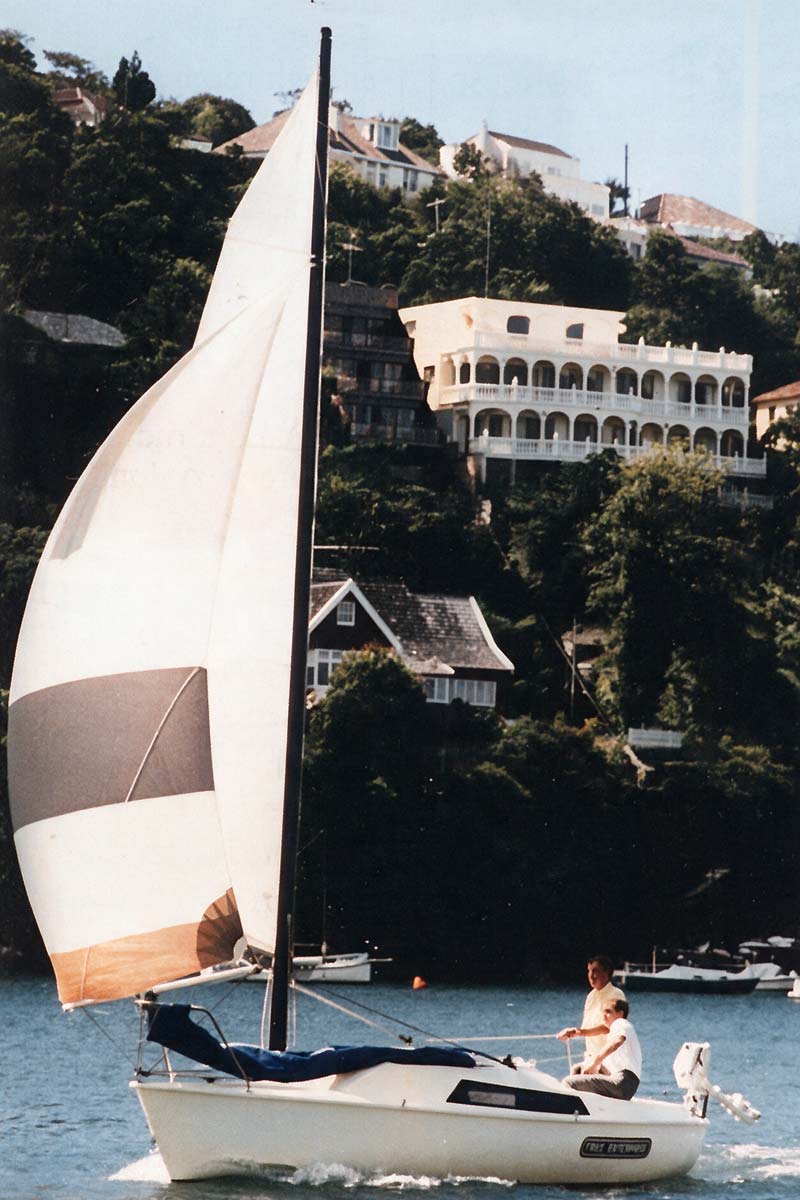
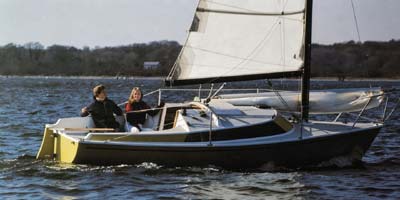
This history leads directly to the Freedom 21, a trailerable cat-rigged vessel that became available in Australia through Tony Barnes of the Middle Harbour Sailing Centre in Sydney. Designed with a light, shallow hull reminiscent of Bruce Farr’s styling, the boat features a wide stern with a squarish transom, an outboard hung rudder, a large cockpit, a low coachroof, and a fairly pointy bow. The hull section is somewhat saucer-shaped with flat aft sections. While a fixed keel version is available, the centreboard model uses twin daggerboards on either side of the centreline rather than a central board. When raised, these daggerboards leave the cabin floor entirely clear, making the cockpit and interior surprisingly spacious for a family day outing. The bow features a heavy-duty pulpit designed to accommodate Hoyt’s gun-mount spinnaker system, one of the boat’s standout innovations.
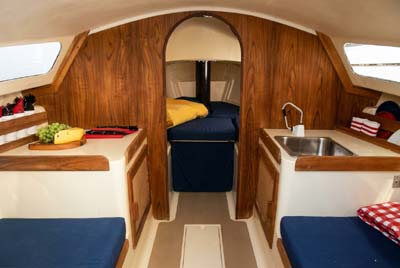
Below decks, the boat makes efficient use of its modest 5.6-metre waterline and 2.4-metre beam. While compact, there is enough room for two people to sleep comfortably on the V-berth in the bow, with space for two additional people on the quarter berths extending aft. Half-partitions separate the bow area from the main cabin, housing the twin daggerboard trunks. The main cabin also provides room for a small stove, a basic galley setup, and under-seat storage bins. Excellent visibility is provided by a wraparound window, and a chemical head can fit neatly under the centre section of the V-berth.
On deck, walking space around the coachroof to the foredeck is uncluttered, though the permanently mounted spinnaker gear occupies the shallow anchor well, making anchor deployment slightly tricky. All sail control lines are led aft through jammers to winches on either side of the hatchway. Because of the unique rig, there are more control lines than on a conventional vessel, eight in total. The test boat featured a American Tiller and Pearson carbon fibre spar, though future models imported into Australia were planned to feature alloy masts built by Goldspar, along with Kenyon booms housing internal reefing lines, outhauls, and vangs.
The defining feature of the Freedom 21 is its gun-mount spinnaker system, designed by Garry Hoyt to eliminate the hassle of traditional spinnaker handling with short-handed crews. The spinnaker pole is permanently attached to a swivel bracket on the bow pulpit. Lines at either end allow a sailor in the cockpit to push the pole forward, swivel it to the desired angle, and set the sail using a halyard, two sheets, two braces, and a retrieval line attached to the centre of the kite. Dropping the sail involves blanketing it behind the mainsail, releasing the halyard, and pulling the retrieval line to pull the spinnaker directly into a permanent turtle bag on deck.
On the water, the boat delivers lively performance, handling gusty conditions over 20 knots with ease. Thanks to its unstayed carbon mast, fully battened mainsail, and wide beam, the boat heels quickly initially before stiffening up as the hull shape and windward daggerboard take effect. In heavy gusts, maintaining control is as simple as easing the main sheet. Downwind, the spinnaker adds an exciting dynamic, though care must be taken during gybes to avoid losing control of the retrieval lines or broaching. Overall, the Freedom 21 is an innovative, high-performing single-handed or short-handed day sailer and weekend cruiser with good build quality.
SPECIFICATIONS:
* LOA: 6.6 m
* LWL: 5.6 m
* Beam: 2.4 m
* Draft (Fixed Keel): 1.14 m
* Draft (Lifting Keel): 1.1 m
* Sail Area: 18.6 m²
* Displacement: 818 kg
* Price (Full Sailaway (1986)):
– Trailerable: $16,950
– Fixed Keel: $15,800
Source: ‘Freedom 21’ Australian Boating, 1986, January, pp. 106-107.
Historical photograph reproduced for identification and historical research purposes. Copyright remains with the original rights holder.
Quick tip: Keep in mind that trailer sailers can vary quite a bit, even within the same class. Take the RL28, for example: they might not all have outboard wells as designed. Some originally may have had inboard engines, and when those were removed, the owners swapped them for a standard outboard mounted on the stern.