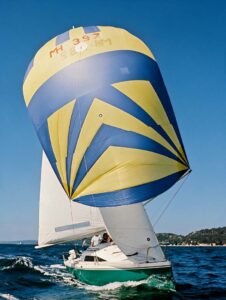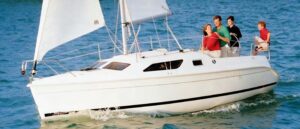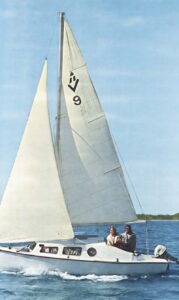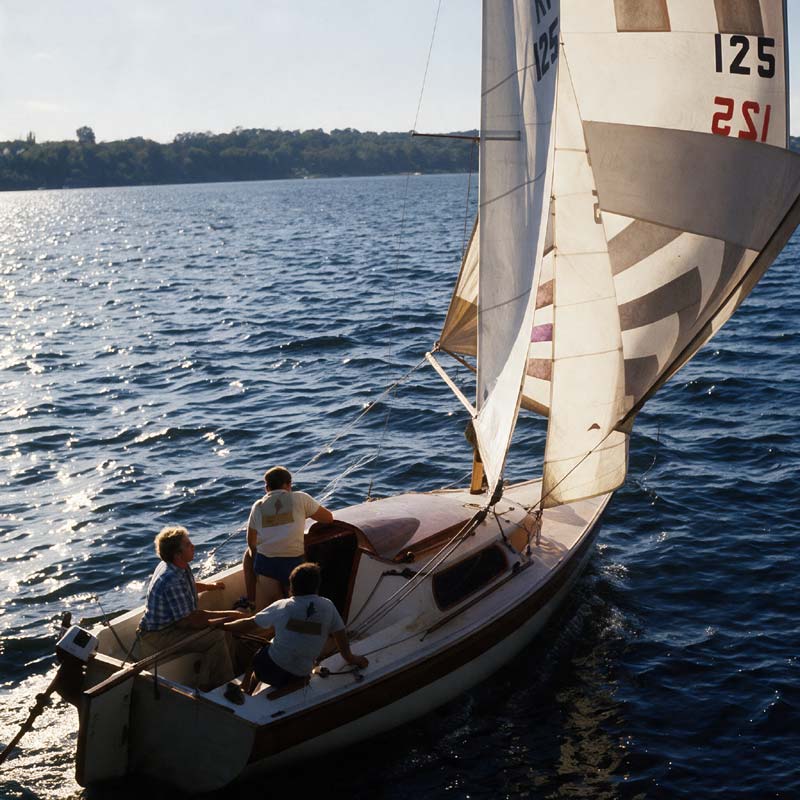
Naval architect Jim Wilshire designed the Court line of trailer yachts to cater to the growing demand for versatile, spacious, and high-performing vessels. Having achieved significant popularity in Western Australia, these designs also gained strong traction at major east coast boat shows. The lineup features both swing-keel and fixed-keel variants of the Court 650 and Court 750, offering options tailored for casual family cruising as well as competitive ocean and river racing.
The Court 650 original swing-keel model stands out as Western Australia’s top-selling trailer yacht, recognized for its thoughtful construction and attention to durability. A key feature is its custom-fabricated aluminium rudder, which delivers exceptional steering control across all weather conditions at twice the manufacturing cost of standard rudders. The hull geometry incorporates a fine, slab-sided entry paired with a wide beam aft, enabling the boat to point exceptionally close to the wind while easily coming onto a plane when reaching or running in moderate winds. Its 225 kg swing keel features a compact, geared arrangement to facilitate effortless winching.
Inside, the Court 650 offers an surprisingly expansive layout for a 6.5-meter vessel, equipped with a pop-top hatch that raises standing headroom to 1.9 meters, a vital comfort feature for extended cruising in warm weather. The interior features elegant teak bunk trims, under-bunk storage cutouts, a folding dinette, a connected sink, dedicated space for a stove and water tank, and a private enclosed area for a head. On deck, it boasts wide side decks, deep coamings for comfortable hiking, and a spacious cockpit fitted with dual storage lockers.
Building on this success, the Court 650 Fixed-Keel model retains the spacious pop-top shelter and layout of the swing-keel version while gaining even more interior volume due to the absence of a centreboard case. The fixed keel design mimics the sleek profile of a fast, modern centreboarder, offering outstanding balance, high point ability, and remarkable downwind stability for a light-displacement hull. Capable of being outfitted to satisfy Category Three ocean racing standards, it serves equally well as a relaxed family cruiser or a capable offshore competitor.
Moving up in size, the Court 750 Swing-Keel addresses the modern demand for “maxi-trailer” yachts, maximizing hull dimensions while remaining manageable to tow. Designed to slide smoothly on and off a heavy-duty, tandem-axle trailer without submerging the wheels in water, the 750 combines convenience with a luxurious, wide-beam interior capable of sleeping five adults comfortably. The layout comprises a private forward cabin, a main saloon with a folding teak table, substantial under-bunk dry storage, deep side pockets, and a practical galley space. Outside, the cockpit comfortably seats six and includes a sealed locker large enough to accommodate a portable icebox.
The Court 750 Fixed-Keel version caters directly to the 24-foot cruising and racing market, drawing design influence from quarter-ton hull profiles to deliver spirited performance against dedicated race boats. From its release, demand outpaced production capacity, supported by an accessible price point of around $12,000 in mid-1978. Designed as a functional, multi-use hybrid rather than a hyper-specialized racer, it features wide side decks suitable for offshore crew work, a foredeck anchor locker that isolates mud and water from the cabin, and a tabernacle-mounted mast on a 7/8 fractional rig for simple hoisting and lowering.
While some owners opt for a simplified cruising setup or an optional small auxiliary diesel engine, the standard performance rig supplied by Rolly Tasker utilizes a Soling-derived mast section with controls routed aft to the cockpit. Key rig adjustments include a flattening reef, two slab reefs, a Cunningham eye, boom vang, adjustable outhaul, twin spinnaker halyards, and a dual-halyard Gemini forestay arrangement for rapid sail changes.
Key Specifications & Technical Features:
* Court 650 Swing-Keel: Features a 225 kg geared swing keel, 1.9 m pop-top headroom, fabricated aluminium rudder, dual cockpit lockers, and Category 3 ocean racing capability.
* Court 650 Fixed-Keel: Features a fixed fin keel resembling a modern centreboarder, increased interior cabin space (no centre case), 6.5 m overall length, and pop-top roof.
* Court 750 Swing-Keel: Accommodates 5 sleepers, seats 6 in cockpit, features forward private cabin, tandem-axle trailer compatibility, and wide-beam stability.
* Court 750 Fixed-Keel: 24 ft length, quarter-ton inspired hull design, 7/8 fractional tabernacle mast, Rolly Tasker Soling-based mast section, dual slab reefs, flattening reef, Cunningham eye, twin spinnaker halyards, Gemini forestay, optional auxiliary diesel, and ~ $12,000 price point (June 1978).
COURT 650 Swing Keel
Specifications:
L.O.A. 6,55 m
L.W.L. 5,93 m
BEAM 2,30 m
DRAFT max 1,31 m
min 0,22 m
DISPL. 830 kg
BALLAST 280 kg
SAIL AREA 14,8 sq m
COURT 750 Swing Keel
Specifications:
L.O.A. 7.32 m.
L.W.L. 6.10 m.
BEAM 2.39 m.
DRAFT max. 1.31 m.
DRAFT min. 0.25 m.
DISPL. 1190 kg.
BALLAST 445 kg.
MAINSAIL 9.90 sq.m.
GENOA 14.44 sq.m.
WORKING JIB 9.82 sq.m.
Source: John Crawford Marine. “Court 650 & 750” Trailer Sailer Library. Accessed October 24, 2026.
https://www.johncrawfordmarine.com.au/advice/trailer-sailer/court-650
https://www.johncrawfordmarine.com.au/advice/trailer-sailer/court-ts-750
Court 650 picture above
Court 750 picture below
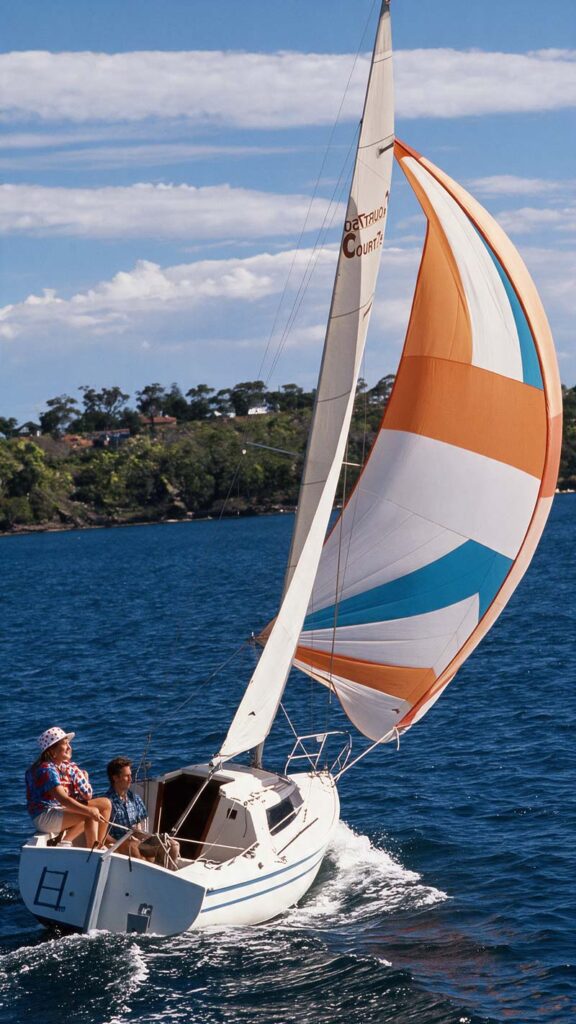
Photograph reproduced for identification and historical research purposes. Copyright remains with the original rights holder.
Quick tip: Keep in mind that trailer sailers can vary quite a bit, even within the same class. Take the RL28, for example: they might not all have outboard wells as designed. Some originally may have had inboard engines, and when those were removed, the owners swapped them for a standard outboard mounted on the stern.