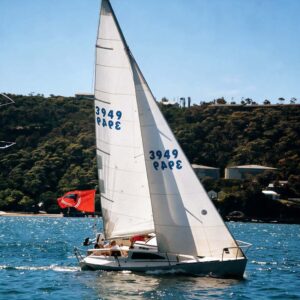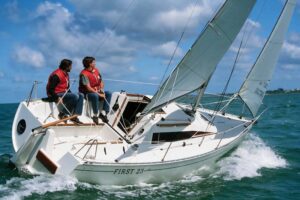
The Blazer is a high-performance trailer sailboat designed by prominent top-tier U.S. yacht designer Doug Peterson, who was commissioned by the Hobie Cat organization in the United States to create a boat for Hobie sailors to step up to. Australian rights to build the design were acquired by Melbourne boatbuilder and offshore sailor Tom Stephenson, whose company, Stephenson Marine, managed international production rights for other countries including the United States. Following its public debut at the Melbourne Boat Show, around ten hulls were sold or ordered, with the boat establishing a strong presence in trailerable yacht racing across Melbourne, the east coast, and surrounding regional centers.
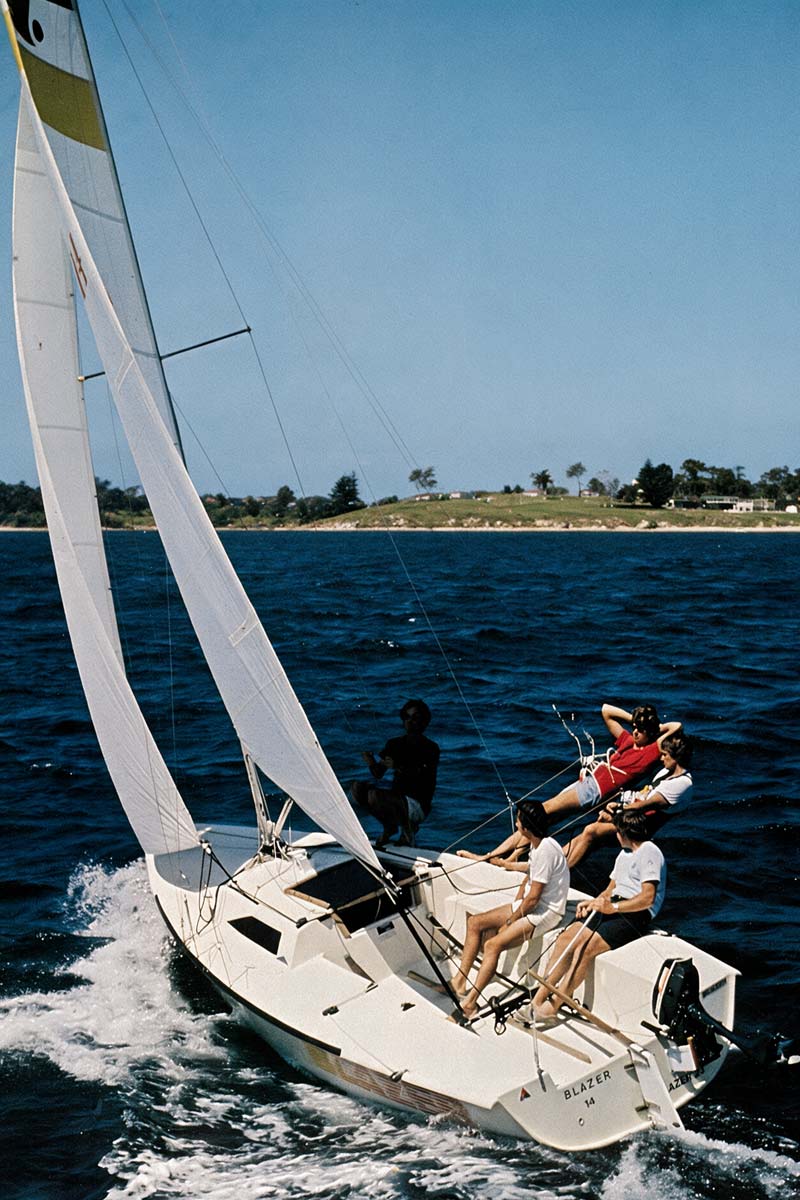
In terms of design and layout, the Blazer essentially functions as a large, planing dinghy fitted with a small cabin. It features a flat planing hull, lightweight construction, and a low ballast ratio of approximately 20 percent. The rig is straightforward, well-organized, and simple to set up, incorporating a three-quarter fractional setup with swept-back spreaders and single shrouds on each side. The layout leaves the cockpit essentially open, providing ample room for a active racing crew. Below deck, the interior is kept minimal to maintain a light overall weight, offering basic accommodation with two occasional berths and full sitting headroom. Standard models feature a fixed blade rudder, while Australian agents J&S Fibreglass introduced a swinging rudder to facilitate easier beaching. The daggerboard slot is integrated into the compression post, with the mast step straddling the slot. On deck, the open cockpit provides comfortable room for four adults on the windward side, complemented by two trapezes fitted on either side for heavy-breeze performance.
Underway, the boat proves exceptionally fast, getting onto a plane easily in prevailing 12 to 15 knot conditions with one crew member out on the trapeze. Upwind in moderate air, both trapezes come into play to keep the flat hull level. While the boat can be sailed without trapezes, doing so significantly reduces both speed and stability. Consequently, the Blazer is not suited for beginners or quiet family cruising, but rather serves as an athletic, high-speed machine that rewards skilled sailors with thrilling performance. Handling remains manageable, with small block and tackle systems controlling the small, 100-percent working jib without requiring winches. The mainsail setup requires active trimming to maintain pointing ability. Downwind performance under the spinnaker is fast and effortless, though precise rudder and tiller connections are necessary to prevent broaching in heavy gusts. Overall, its ease of trailering, quick rigging, and thrilling sail dynamics make it an exciting option for former dinghy sailors seeking a high-speed trailer yacht (Davidson, Antill and Lewis 1982, pp. 44-45).
SPECIFICATIONS:
* LOA: 7m (23′ 00″)
* LWL: 6.2m (20′ 6″)
* BEAM: 2.43m (8′ 00″)
* DRAFT BOARD UP: 0.23m (0′ 9″)
* DRAFT BOARD DOWN: 1.29m (4′ 3″)
* WEIGHT: 770kg (1700lb)
* BALLAST: 159kg (350lb)
* SAIL AREAS (MAIN): 13.2 m² (142 Sq. ft.)
* SAIL AREAS (JIB): 9.3 m² (100 Sq. ft.)
* SAIL AREAS (SPINN): 32.5 m² (350 Sq. ft.)
Source: Davidson, Antill and Lewis (1982) ‘Blazer’ Australian Boating, January, pp. 44-45.
Historical photograph reproduced for identification and historical research purposes. Copyright remains with the original rights holder.
Quick tip: Keep in mind that trailer sailers can vary quite a bit, even within the same class. Take the RL28, for example: they might not all have outboard wells as designed. Some originally may have had inboard engines, and when those were removed, the owners swapped them for a standard outboard mounted on the stern.