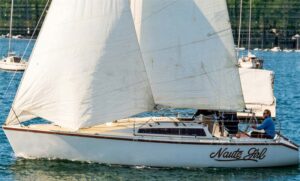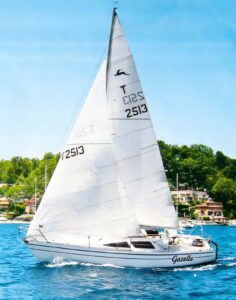
Every so often, a sailboat arrives that perfectly fits a niche, seamlessly integrating into the local waterfront community to the point where sailors wonder how they ever managed without it. Kim Swarbrick’s S-80 is precisely one of those designs. This eight-metre harbour racing vessel is at the forefront of a wave of ultralight, high-performance harbour racers that have breathed new life into competitive sailing across Australia. In its initial debut year in Western Australia, over 50 hulls were sold, and current numbers point to more than 150 of these boats actively racing in major sailing states, proving its widespread appeal and rapid adoption.
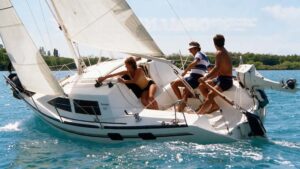
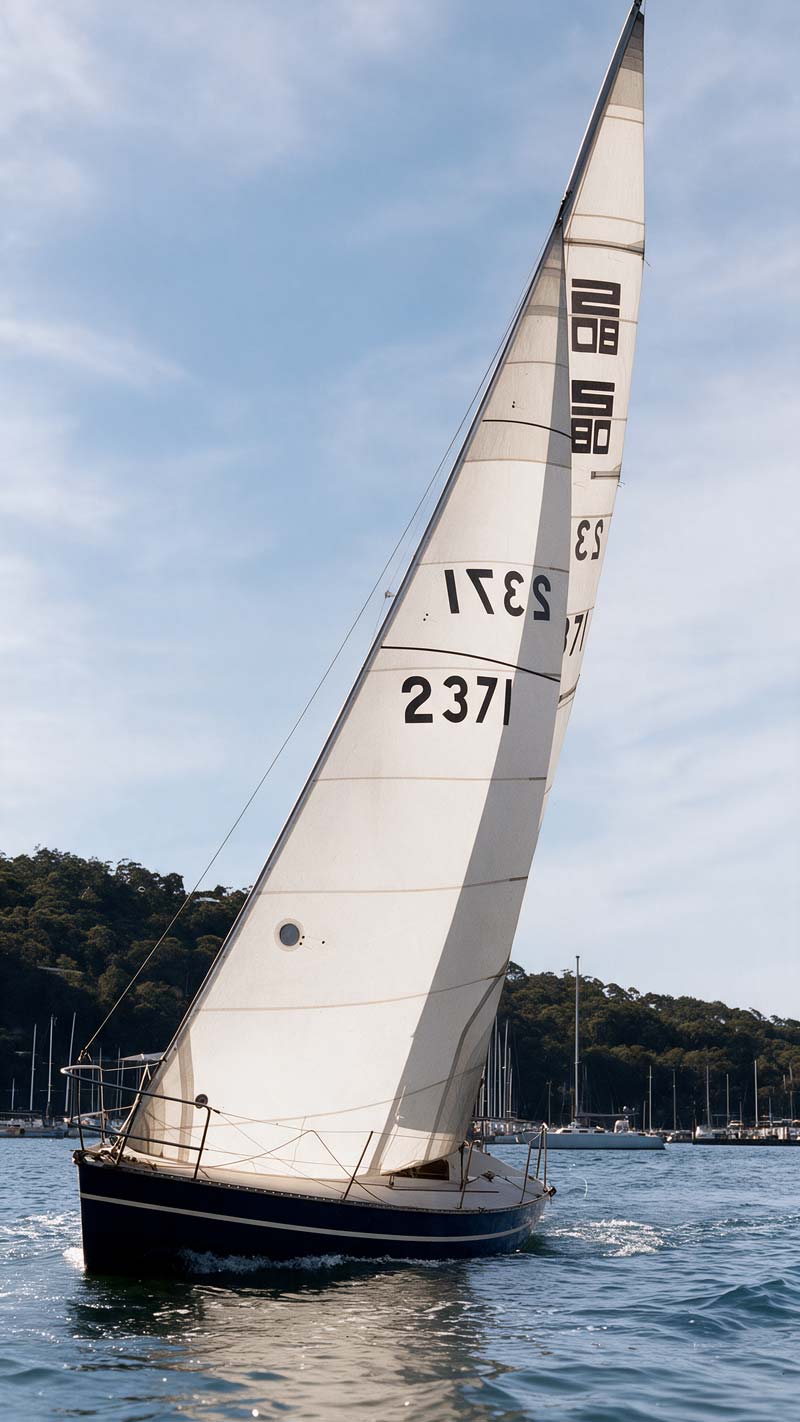
The S-80 is fundamentally designed like a massive skiff equipped with a deep rudder and a dagger-type fin keel. When resting in the water, the hull barely sits below the surface; without its keel, it would draw only a matter of centimetres. Its design features a very long waterline relative to its overall length, with hull extensions known as “planing boards” extending past the sheerline at the stern by about 125 millimetres. Beyond extending the waterline length, these boards serve as a convenient step when boarding the yacht. The bow features a sharp, knife-like profile leading into a very flat underside aft, with only a subtle rounding toward the front section. Notably, its maximum beam of 2.7 metres is carried well aft, keeping the transom almost as wide as the section at the shrouds.
The cockpit measures 2.28 metres long by 1.5 metres wide, offering ample room to comfortably seat six people in cruising mode. The cockpit seats feature curved mouldings that provide comfortable seating positions while the boat is heeled. However, given the competitive nature of the class, crew members rarely sit inside the cockpit when racing to windward; instead, they sit on the coamings, which are admittedly somewhat firm and uncomfortable. Storage includes two lockers located in the cockpit alongside an anchor well situated on the foredeck.
In terms of construction, the hull is hand-laid using chopped strand mat and woven rovings. The alloy toe rail forms an integral part of the hull-to-deck joint, providing structural integrity. To keep the boat upright, a cast-iron ballast is securely bolted into the keel structure. The deck moulding makes generous use of non-skid surfaces, while the interior offers a functional, albeit spartan, arrangement supported by prefabricated interior moulds.
The rig configuration is a fractional setup featuring back-swept spreaders, dual shrouds per side, and a flexible, bendy spar. The backstay utilizes a small tackle system that allows the main to be flattened out when sailing in higher winds, controlling a generous mainsail measuring 18 square metres. The mainsheet traveller is positioned in the centre of the cockpit, spanning between the seats. The boom extends almost all the way to the transom, leaving only about 1.3 metres of clearance above the cockpit sole in racing trim, though a flattening reel can be rigged for cruising to improve overhead clearance (Davidson 1981, pp. 63-65).
SPECIFICATIONS
Dimensions & Weight:
* LOA (Length Overall): 8.00 m
* LWL (Length Waterline): 7.10 m
* Beam: 2.70 m
* Draft: 1.40 m
* Displacement: 1.40 tonnes
* Ballast: 550 kg
Sail Area:
* Main: 18 sq. m.
* No 1 Genoa: 19.4 sq. m.
* No 2 Genoa: 15.8 sq. m.
* No 3 Jib: 13.9 sq. m.
* Spinnaker: 51 sq. m.
Additional Features & Details:
* Designer: Kim Swarbrick
* Hull Type: High-performance harbour racer / big skiff style with deep rudder and dagger-type keel
* Hull Construction: Hand-laid chopped strand mat and woven rovings with integral alloy toe rail
* Interior & Deck: Non-skid deck surfaces, spartan interior with prefabricated moulds, two cockpit lockers, foredeck anchor well
* Seating: Curved cockpit seat mouldings designed to fit 6 people in cruising mode
* Rigging: Fractional rig, back-swept spreaders, bendy spar, 2 shrouds per side, cockpit traveler.
Source: Davidson, Mike (1981) ‘S80: Harbour Racer Superb’ Australian Boating, August, pp. 63-65.
Historical photograph reproduced for identification and historical research purposes. Copyright remains with the original rights holder.
Quick tip: Keep in mind that trailer sailers can vary quite a bit, even within the same class. Take the RL28, for example: they might not all have outboard wells as designed. Some originally may have had inboard engines, and when those were removed, the owners swapped them for a standard outboard mounted on the stern.