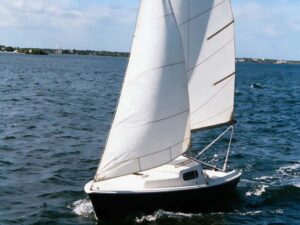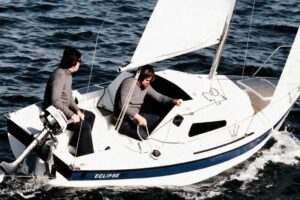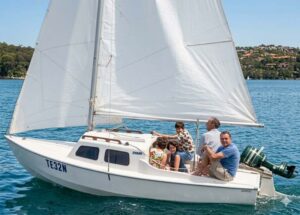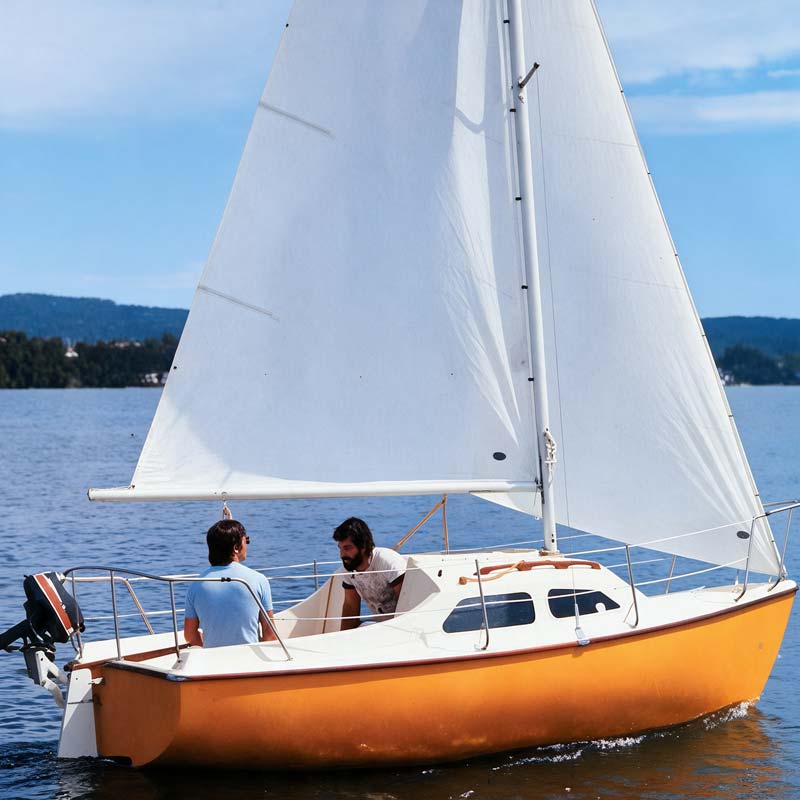
The Tropic 520 is a trailer sailer constructed in Australia that features a unique open cabintop design and exceptionally robust glass-reinforced plastic construction. Originally designed in New Zealand by Alan Wright, who is widely regarded as a leading designer of cruising yachts, the vessel was initially known as the Monarch 17. The design built a strong reputation across the Tasman as a dependable seaboat, with roughly 140 units produced in New Zealand by Tasman Yachts. In Australia, the vessel is manufactured by Tropic Trailer Yachts in Lisarow under the direction of Phil Kershler, alongside Gwlyn Jones, the former owner of Tasman Yachts. Together, they produce three models in the Tropic line, with approximately 20 units of the 520 model sold locally early in its production run.
Both Kershler and Jones bring extensive fibreglass moulding experience to the boat’s design, sharing a strong philosophy against lightweight GRP hulls. They contend that fibreglass cannot simply match the thickness of plywood because plywood offers greater structural strength at a given thickness. To prevent hull flexibility and long-term structural issues, they prioritize heavy, stiff glasswork. The hull of the Tropic 520 weighs roughly 416.7 kilograms and carries an additional 181 kilograms of ballast. Structural reinforcement is evident throughout the build, including a balsa core sandwich construction for the cockpit floor and foredeck, timber glassed under all cleat locations, and heavy-duty stainless steel angles securing the gunwales right through the skins. Safety features include 19 cubic feet of enclosed foam flotation providing full buoyancy even when fully laden, an open foredeck anchor well, and a complete safety line system spanning from pulpit to pushpit.
During sea trials conducted on New South Wales’ Tuggerah Lakes, the boat demonstrated pleasant and capable handling. Towed easily on a trailer with double tie-downs, the vessel was launched at The Entrance Aquatic Club ramp. On the water, the Tropic 520 proved easy to tack and exhibited only a slight weather helm, which was easily mitigated by raising the centreboard slightly. While the test vessel was set up for family cruising rather than racing, lacking accessories such as a mainsheet traveller or boom vang, the underlying design boasts competitive lineage. In New Zealand, the Monarch 17 achieved a sixth-place finish in the national open restricted trailer sailer championships. Reviewer Paul Hopkins noted that while the boat handles like a responsive dinghy under sail, it maintains the reassuring stability and feel of a small yacht.
The interior layout features standard accommodation for four adults, comprising forward vee-berths and spacious quarter berths with generous hip room. A standout architectural element inside the cabin is the mast support, which consists of an inverted U-beam laminated from mahogany and white pine. This beam encircles the interior and notches into side supports, securing directly to the above-deck mast step with a large stainless steel bolt and plate. Combined with the unusually large companionway, this design creates an airy, open-air feeling below deck. Rather than a conventional sliding hatch, the cabin uses a soft top for weather protection, with a GRP hardtop and washboards available as an alternative. While the open design raises minor questions regarding lock-up security and water ingress during heavy seas, the builders confirmed the vessel is fully insurable and well-protected against rain and spray (Hopkins, p. 18ff).
SPECIFICATIONS:
* Model: Tropic 520 (originally designed as the Monarch 17)
* Designer: Alan Wright (New Zealand)
* Manufacturer: Tropic Trailer Yachts Pty Ltd, Lisarow, NSW, Australia
* Type: Heavy-construction GRP trailer sailer with camping roof
* Length Overall (LOA): 5.20 m
* Length Waterline (LWL): 4.72 m
* Beam: 2.18 m
* Draft: 300 mm (board up) / 1.05 m (board down)
* Headroom: 1.37 m
* Ballast: 181 kg (centerplate weighs 27.22 kg with 154.24 kg lead ballast forward of the case)
* Displacement: 589.7 kg
* Sail Area: 15.75 sq m (sloop rig, 7/8 fractional)
* Accommodation: 4 adults (vee-berths and quarter berths)
* Price (Stage I): $2,740 (hull, deck, buoyancy tanks, lead and centreplate, mast supports, interior flowcoat, cutouts)
* Price (Stage II): $3,400 (adds mast, bow, rudder assembly, handrails, toe-rails, hatch cover, deck fittings)
* Complete Boat Price: $5,200 (ready to sail)
* Test Boat Price (October 1977): $6,747 (includes trailer, bow rail, cushions, motor bracket, pushpit, stanchions, lifelines)
Source: Hopkins, Paul ‘Tropic 520’ Seacraft, n.d, p. 18ff.
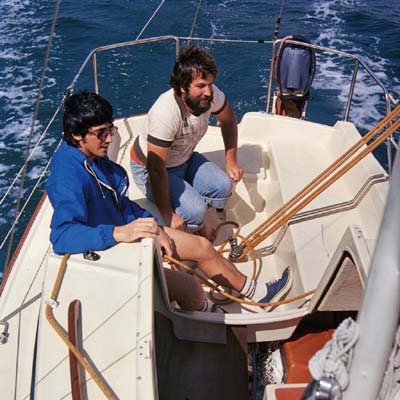
Historical photograph reproduced for identification and historical research purposes. Copyright remains with the original rights holder.
Quick tip: Keep in mind that trailer sailers can vary quite a bit, even within the same class. Take the RL28, for example: they might not all have outboard wells as designed. Some originally may have had inboard engines, and when those were removed, the owners swapped them for a standard outboard mounted on the stern.