
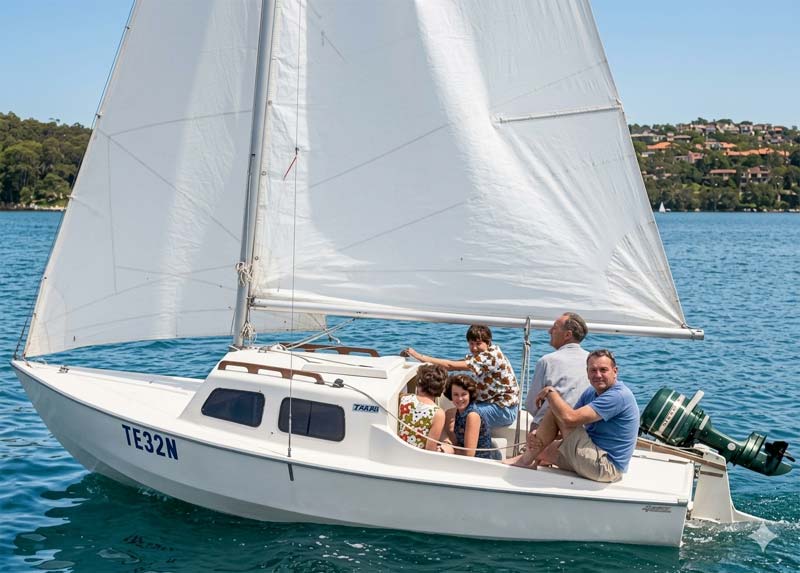
Fully rigged, the 17-foot yacht weighs approximately 1,288 pounds (584kg) and is built with durability in mind. Its fibreglass hull, deck, cockpit, and cabin are well finished, complemented by attractive teak trim around the twin companionway openings, bunks, and centreboard casing.
Access to the cabin is provided by two companionway openings positioned on either side of the centreboard case. Hinged covers lift easily for entry and, when closed with the boards in place, the cabin can be securely locked while the boat is on a mooring.
Safety has been given considerable attention. The boat is fully self-draining and contains substantial flotation beneath the cockpit floor, hull sides, and bunks. Cockpit water exits through transom-mounted drains fitted with shock-cord-retained flaps. The starboard outboard well drains independently, allowing the space beneath the aft deck to be used for storing fuel tanks and other gear.
The cockpit is spacious and deep, providing a comfortable area for the crew, although the low coamings offer limited back support, particularly for the helmsman near the stern.
Inside the cabin, full-length berths with thick mattresses provide accommodation for two adults. Storage space is available beneath shelving and in side compartments, while the anchor rope is led through a deck-mounted bollard designed to minimise water entering the cabin.
Natural light enters through four windows, two on each side and two forward, creating a bright interior. Well-positioned teak handrails on the cabin roof aid movement around the boat, and the side decks provide adequate footing. Effective non-slip surfaces on the deck and cabin top improve safety, though moving forward in rough conditions may still require caution due to the absence of bow rails.
When carrying a full crew along with an outboard motor and fuel, the concentration of weight aft caused the boat to lift its bow noticeably under strong acceleration. Nevertheless, handling under power proved responsive and manoeuvrable. The boat is said to do 10 knots under power, if pushed.
The sailing rig is straightforward, incorporating a forestay, shrouds, and diamond stays. Chainplates are located well aft of the mast, which increases mast support but restricts the boom from being squared fully when sailing downwind. This arrangement is unlikely to concern cruising sailors more interested in relaxed sailing than racing performance.
Tested in light winds of 10–15 knots, the yacht demonstrated satisfactory performance. Owners reported that it remained stable and confidence-inspiring in stronger 20-knot conditions. Its substantial displacement and broad beam contribute to its solid feel and resistance to heeling.
Upwind performance was respectable despite the boat carrying a significant crew load. The deep, narrow rudder occasionally wandered off course, and weather helm was present when the boat was heeled. When sailed upright, helm balance was much lighter.
The mainsail and jib provided a total sail area of 186 square feet. While suitable for cruising, the sail trim and setup were not optimised for racing, leaving room for refinement.
Overall, the boat impressed as a robust and family-friendly trailer sailer designed for safe and enjoyable cruising. Its combination of strength, stability, and practical features makes it well suited to sailors seeking relaxed weekends on the water. Together with several other trailer sailers available at the time, it offered families an accessible and rewarding way to enjoy sailing without sacrificing comfort or safety.
- FACT BOX
-
BOAT: Bell Boy 17-foot fibreglass trailer sailer.
-
BUILDER: Freighter Industries (SA) Pty Ltd, Seaton, SA.
-
OWNER: Mr R. G. Courtney, Beacon Hill, NSW.
-
HULL: Fibreglass double chine, 17 ft overall, 7 ft 4 in. beam. Has well raked, fine bow, and strong planing sections aft.
-
DECK/CABIN: Fibreglass, one-piece construction joined to hull at gunwale. Incorporates large self-draining cockpit. Decks impregnated with special anti-slip covering.
-
SAIL AREA: 186 sq ft, sloop rig (main approx 117; jib approx 69).
-
SPARS: Alloy extrusions, internal track.
-
CENTREBOARD: 3/8 in. mild steel. Raised by simple block and tackle system. Very shallow draft with board raised.
-
ACCOMMODATION: Cabin (can be completely sealed) with two bunks. Has room for toilet and sink.
-
WEIGHT: 1288 lb rigged.
-
AUXILIARY POWER: By outboard, up to 20 hp.
Source: Hopkins, Paul (1971) ‘Non-Skid and All Glass’ Seacraft, January, p. 40. Historical photograph reproduced for identification and historical research purposes. Copyright remains with the original rights holder.