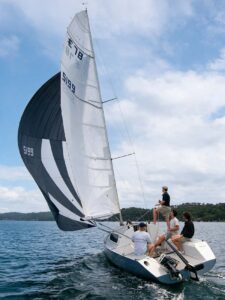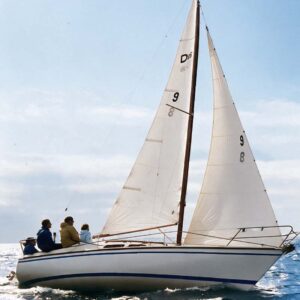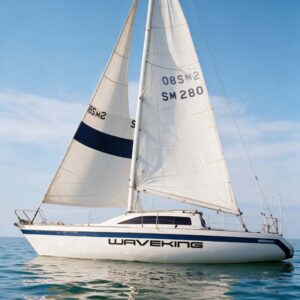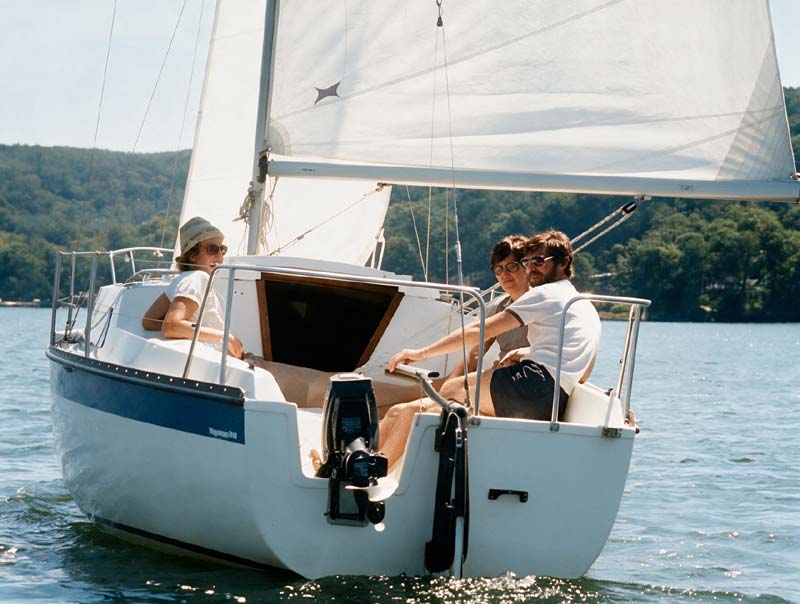
The Timpenny 770 stands out as a genuine trailer sailboat that offers hassle-free launching and recovery, functioning just like any standard trailer sailer despite its generous dimensions. During testing, the vessel was towed to Melbourne, demonstrating its practical roadability.
Designed by Colin Thorne as a roomier upgrade for his family after outgrowing the popular Timpenny 670, the 770 cleverly accommodates up to six people within a hull shaped like a dinghy. It features lines similar to Iain Murray’s South Coast 22 design, including a sharp razor bow, wide middle sections, and a flat aft run. The boat retains the low freeboard, agile dinghy feel, and self-tacking headsail design of its predecessor, though it trades the older model’s pilot-style front windows for a modified look. The cockpit feels noticeably spacious, enhanced by comfortable coamings for hiking out, a pop-top roof for extra headroom, a main traveller mounted on the bridge deck, and an integrated anchor well on the foredeck.
Below deck, the layout is designed for maximum space and comfort, easily accommodating four adults and two children for extended periods. The central centreboard casing is fitted with a drop-leaf table for dining, while the galley and sink are positioned against a partial bulkhead so the cook has dedicated space. Accommodation includes a large forward vee-berth and extended saloon settees that turn into quarter berths. An alcove created between the bulkhead and centreboard casing holds the toilet facilities, which can be partitioned off for privacy, while plenty of storage is available throughout, with room under the companionway to house an optional inboard engine.
Rigging on the Timpenny 770 relies on a three-quarter fractional rig with a self-furling, self-tacking headsail running on a traveller set in front of the mast. The rig features one cap shroud, one lower shroud, and an adjustable backstay, along with a loose-footed mainsail controlled by an outhaul, downhaul, and vang, building upon the simple trailer-sailer rigging concept pioneer-built into the earlier 670 model.
On the water, the vessel behaves very much like a large sailing dinghy, responding immediately to fine sail trim and mainsheet adjustments. In light breezes under eight knots, the boat proved nimble and well-balanced with no weather helm on the tiller, aided by a deep rudder blade that provides substantial leverage. While heavier winds require working the traveller to maintain stability, the increased size of the 770 slows down the vessel’s reactions compared to smaller models, giving the crew more time to adjust and comfortably handle diverse sailing conditions.
Specifications
-
LOA: 7.70m
-
LWL: 7.18m
-
Beam: 2.45m
-
Draft:
-
Keel Up: 0.28m
-
Keel Down: 1.42m
-
-
Ballast: 410kg
-
Sail Area:
-
Main Sail: 14.9 sq.m.
-
Jib: 8.5 sq.m.
-
Spinnaker: 29.7 sq.m.
-
Source: ‘Timpenny 770’ Australian Boating, 1981, May, p. 72.
Historical photograph reproduced for identification and historical research purposes. Copyright remains with the original rights holder.
Quick tip: Keep in mind that trailer sailers can vary quite a bit, even within the same class. Take the RL28, for example: they might not all have outboard wells as designed. Some originally may have had inboard engines, and when those were removed, the owners swapped them for a standard outboard mounted on the stern.