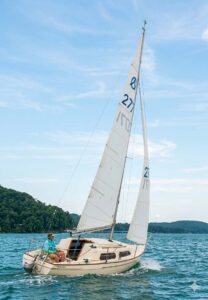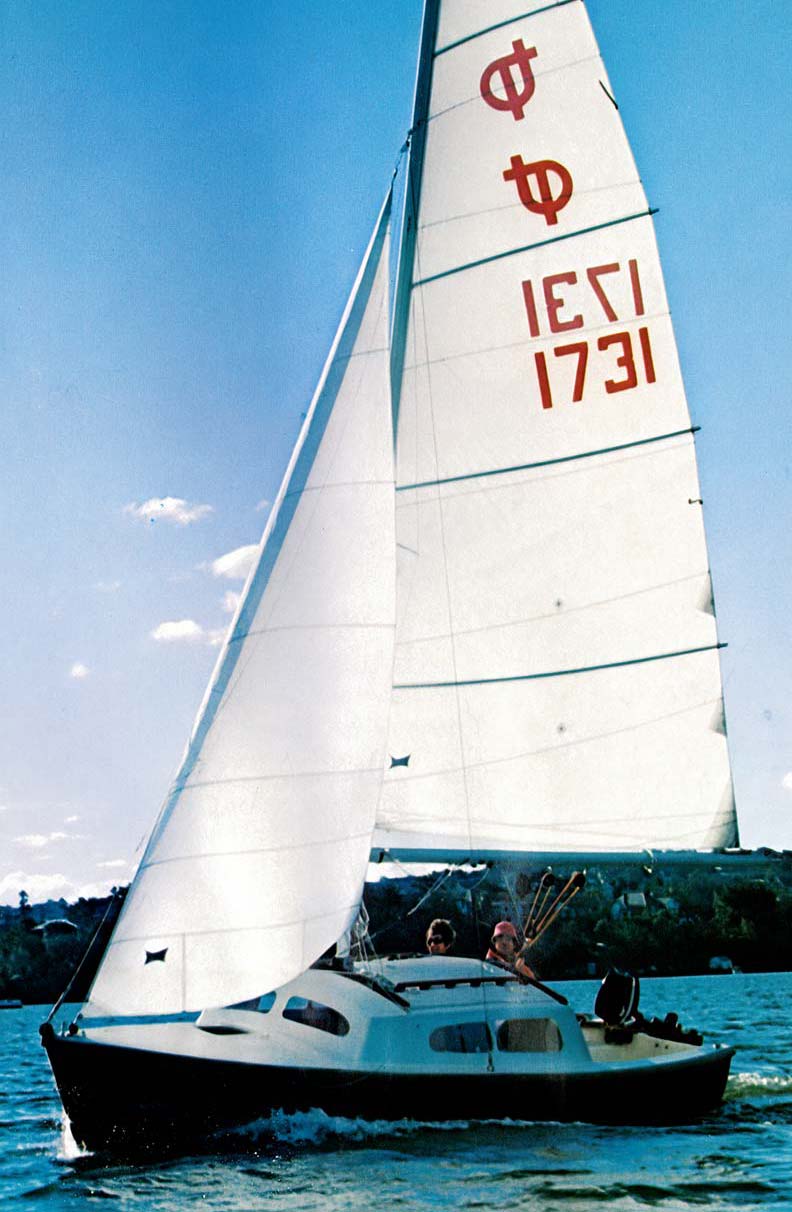
The Timpenny 670 is a highly-tuned, 6.7-metre trailerable yacht that ranks closely behind the RL24 as one of the fastest trailer sailers in Australia. Designed by Colin Thorne and built by Timpenny Yachts in Hunters Hill, New South Wales, the boat grew out of Thorne’s family sailing background with NS14s and his desire to build a safe, fast, and affordable family trailer sailer.
First impressions of the Timpenny 670 highlight its neat, uncluttered deck profile, which avoids oversized cabin superstructures. The cockpit is spacious, comfortably seating up to six people, with wide coamings running out to the sides and self-draining ports in the transom to keep feet dry. The boat is rigged with a rotating, diamond-rigged mast that allows the mainsail to set quickly and cleanly on a tack. It features a loose-footed main, a self-tacking jib with a full-width traveller, and a transom-hung blade rudder that provides responsive, dinghy-like steering.
While it is exceptionally fast off the wind and points well to windward, the reviewer notes that it is not strictly rigged for heavy offshore cruising without some beefing up. The small forehatch is tight for a large person, and safety precautions like adding a pulpit, life lines, and a pushpit are recommended since the foredeck can feel exposed.
Below decks, the layout prioritizes practical space, offering sitting headroom, accommodation for four to five adults across a double forward berth and quarter berths, and space for a chemical toilet and stove. Two layouts are available (console and dinette), with the console version placing the galley bulkhead forward to improve air circulation and seat four comfortably around the table formed by the centreboard housing.
The hull is constructed from hand-laid chop strand and woven rovings with a speckled-hen exterior finish typical of Australian-built yachts. Instead of a full GRP interior liner (avoided to save weight and cost), owners are free to customize the interior lining. The saloon floor is reinforced with end-grain balsa sealed in fibreglass, tying the keel box directly to the hull to withstand side forces.
The boat’s centerpiece is its heavy 0.2-tonne (220 kg) lead and fibreglass drop keel, which drops nearly a metre below the hull to provide a strong 30% ballast ratio. Raising the keel takes about 45 seconds using a stainless-steel rod and tackle system once the holding wing nuts are removed. Safety is a core design philosophy: the boat features extensive built-in foam buoyancy (providing over 100% positive buoyancy even when fully swamped) and companionway design proven through capsize and self-righting tests to float well clear of the water.
Commercially, the Timpenny 670 is marketed as an affordable option. The basic sailing version includes sails, spars, and deck fittings. Backed by an impressive racing record, such as winning a CYC winter race by substantial margins on handicap, Thorne asserts that the boat’s heavy, low-down drop keel and overall design make it a fierce and economical competitor on the water (Hopkins 1975, p. 6ff).
Specifications
-
Boat: Timpenny 670, drop keel fibreglass trailer sailer
-
Builder: Timpenny Yachts, 8 George Street, Hunters Hill, NSW
-
LOA (Length Overall): 6.70 m
-
LWL (Length Waterline): 6.17 m
-
Beam: 2.30 m
-
Draft: 0.25 m (keel up) and 1.19 m (keel down)
-
Drop Keel: Lead and fibreglass, 0.2 tonne
-
Sail Area: Main 12.5 m²; jib 6.1 m²
-
Accommodation: Four or five adults, available in two layouts (console and dinette)
Source: Hopkins, Paul (1975) ‘Australia’s Second Fastest Trailer Sailer’ Seacraft, September, p. 6.
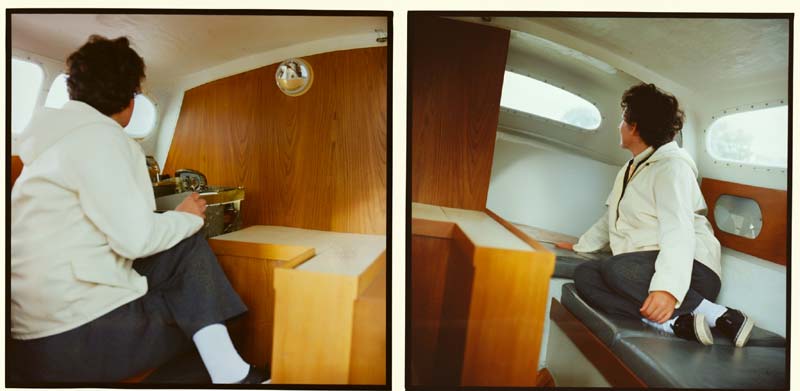
Historical photograph reproduced for identification and historical research purposes. Copyright remains with the original rights holder.
Quick tip: Keep in mind that trailer sailers can vary quite a bit, even within the same class. Take the RL28, for example: they might not all have outboard wells as designed. Some originally may have had inboard engines, and when those were removed, the owners swapped them for a standard outboard mounted on the stern.