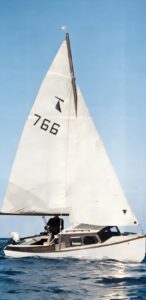
Rover, a 14-foot boat built and designed by Dennis Knight of Green Point, Gosford, NSW, is billed as one of the world’s smallest bilge-keel yachts and the vessel was created to be easily trailed behind a standard car while still offering enough cabin space to comfortably sleep two people. The layout emphasizes practicality for family day-sailing, featuring a spacious six-foot-long cockpit, a tabernacle-hinged mast for easy lowering, and an economical home-built cost of $500 (1968) including sails.
Constructed using double-chine marine plywood over timber frames, the boat incorporates a unique cost-saving measure: twin bilge keels cast from common concrete reinforced with steel mesh. Structurally, the Rover features a 14-foot length overall, a 6-foot beam, a draft of 1 foot 6 inches, and a total sail area of 132 square feet split between a mainsail and a genoa. Its low weight, stability, and shallow draft make it an accessible, budget-friendly option designed to perform well in moderate breezes.
Specifications:
-
LOA (Length Overall): 14 ft
-
LWL (Length Waterline): 13 ft 3 in.
-
Beam: 6 ft
-
Draft: 1 ft 6 in.
-
Ballast: 300 lb min
-
Sail Area: 60 sq ft mainsail, 72 sq ft genoa
-
Mast: 20 feet high, box-section
-
Keels Weight: 200 lb each (twin bilge keels)
-
Total Cockpit Weight / Weight on Trailer: Approx. 7 cwt (784 lb)
-
Home-Built Cost: $500 (including Terylene sails)
-
Designer & Builder: Dennis Knight, Green Pt, Gosford, NSW
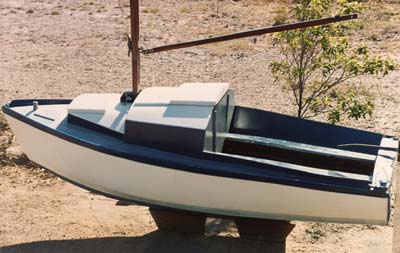
Historical photograph reproduced for identification and historical research purposes. Copyright remains with the original rights holder.
Quick tip: Keep in mind that trailer sailers can vary quite a bit, even within the same class. Take the RL28, for example: they might not all have outboard wells as designed. Some originally may have had inboard engines, and when those were removed, the owners swapped them for a standard outboard mounted on the stern.