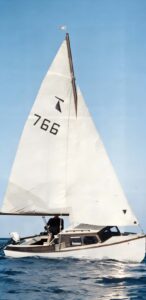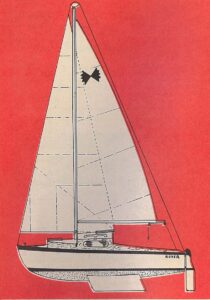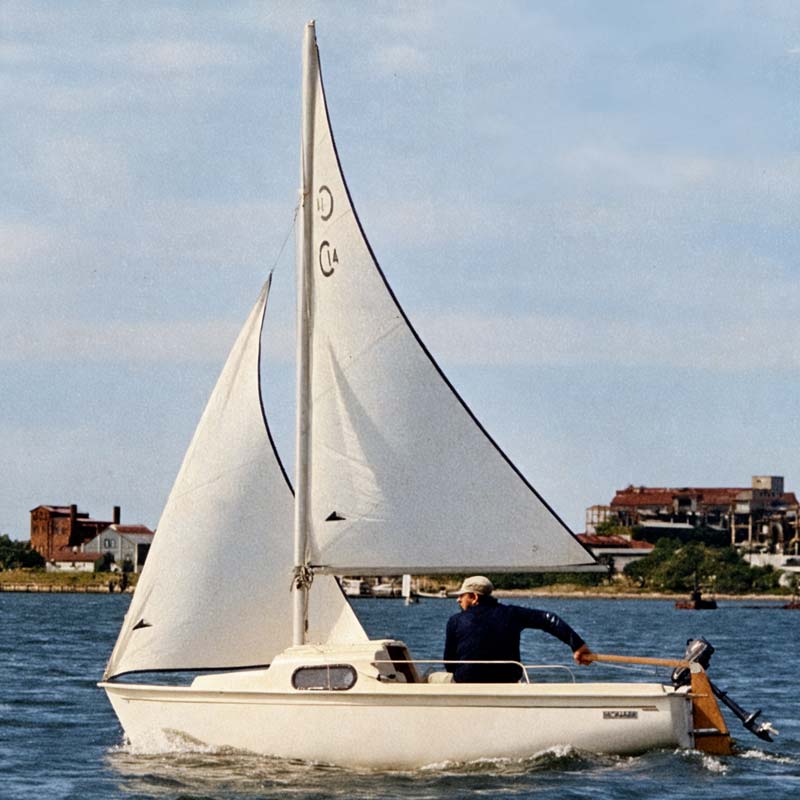
The Caddie 14 Trailer Sailer (TS) represents a compact design that tests the lower limits of practical size for a trailer sailable cabin craft. Measuring 4.16 meters (13 feet 8 inches), the vessel has a storied production background in Australia. Originally marketed as the Bluefin by Hamlyn Publishing Company, the design saw limited interest during its initial Sydney Boat Show debut. It later re-emerged in Queensland as the Cal 14, featuring a swing keel in place of its original twin bilge keels, before being offered in New South Wales under the Caddie 14 name by Wykan Investments, a subsidiary of Brisbane-based Monark Boats.
Constructed with a conventional displacement hull form, the Caddie 14 features a long, broad keel, a curved buttock line sweeping up to an almost wineglass-style transom, and a relatively narrow beam compared to its length. This hull design allows the transom to remain clear of the water under normal loads, reducing drag. While initial stability is light, the heavy built-in hull ballast stiffens the boat quickly as it heals. Under power, a long-shaft outboard engine is recommended due to the high displacement hull design. The recommended capacity is three adults, or two adults with two children, though overall interior and cockpit space remains tight.
The interior cabin offers limited headroom of two feet seven inches, which is sufficient for occupants to sit cross-legged or recline. The cabin floor, measuring four feet two inches wide by over six feet long, can accommodate two air mattresses for overnight camping or store gear out of the weather. Cabin access is provided via a two-part folding hatch that can be secured externally with a padlock. However, the boat lacks dedicated built-in storage areas; two cut-out sections beneath the aft cockpit seats allow fishing over the stern, but these require modification to safely hold items like fuel tanks or anchor gear. The centreboard casing is compact, housing a galvanized steel blade that can be removed externally by removing bolts through a recess in the keel.
The cockpit accommodates three to four people, though movement becomes restrictive under sail. Non-skid surfacing is applied to the cockpit seats, floor, and the forward edge of the cabin top, though additional non-skid coating is needed near the main hatch area, which can become slick. Standard equipment includes stainless steel guard rails, though these restrict movement during tacking and when leaning out during wind gusts.
Under sail, the boat performs more like a motor sailer than a pure sailboat. The sail plan features a main sail and an oversized jib/genoa that provides considerable power. In light winds of 6 to 8 knots, the boat easily achieves its hull speed of approximately five knots. In stronger breezes around 10 knots or higher, the craft reaches its speed limit and tends to round up into the wind even when sails are eased, as the mainsail lacks reef points or cringles for depowering. Rigging controls include an athwartships traveller, an adjustable gooseneck for luff tension, a clam cleat setup for the jib sheets, and a jam cleat double-block system for the main sheet. The narrow beam of five feet two inches allows the boat to be towed behind a standard two-litre car without requiring extended side towing mirrors.
SPECIFICATIONS & DATA
Model: Caddie 14 TS
Test Boat Provider: Wykan Investments, Castle Hill, NSW
Length Overall (LOA): 4.16 m (13 ft 8 in)
Beam: 1.57 m (5 ft 2 in)
Draft: 0.3 m (1 ft)
Displacement: 249 kg (550 lb)
Ballast: 112 kg (250 lb)
Sail Area: 8.9 sq m (96 sq ft)
Retail Price (August 1978): $2920 (including rig and trailer)
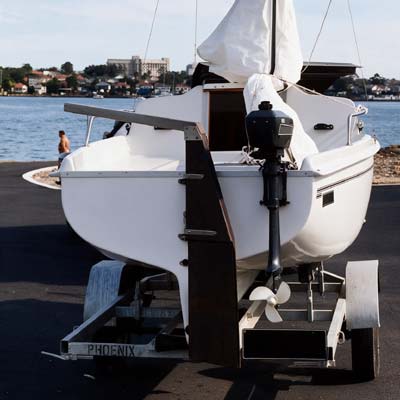
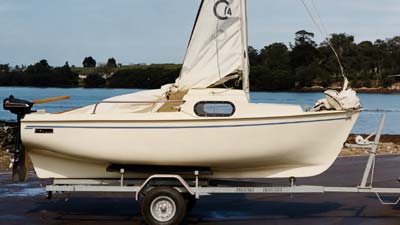
Historical photograph reproduced for identification and historical research purposes. Copyright remains with the original rights holder.
Quick tip: Keep in mind that trailer sailers can vary quite a bit, even within the same class. Take the RL28, for example: they might not all have outboard wells as designed. Some originally may have had inboard engines, and when those were removed, the owners swapped them for a standard outboard mounted on the stern.