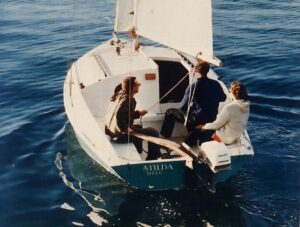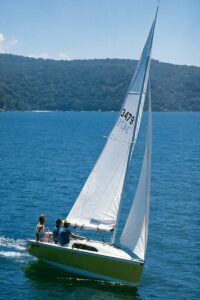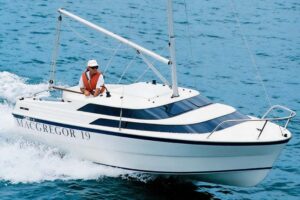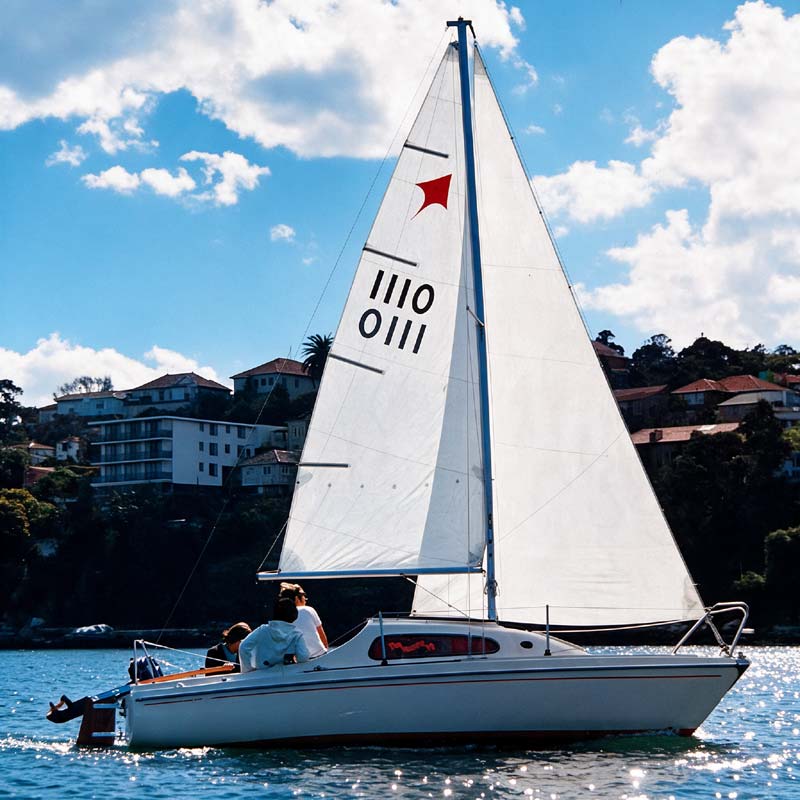
The Manta 19, designed in Austria, manufactured in England by Blakes Marine Services, and imported to Australia by Ekedo Pty Ltd, stands out as a genuine fin-keel sloop with trailerable capabilities rather than a conventional trailer sailer. First presented to the public at the 1977 Sydney Boat Show, the vessel attracted strong interest from existing trailer sailer enthusiasts. Unlike many boats of comparable size that sacrifice proportions for space and look like floating caravans, the Manta 19 maintains sleek, classic lines while optimizing its modest two-meter beam.
Launching and retrieving the boat requires a bit more effort than standard centreboard models due to its fixed 0.46-meter skeg and keel. To handle launching, the specialized trailer must be submerged deep into the water using a chain while the tow vehicle stays dry on the ramp. This process takes extra time, demands a steep ramp, and puts additional wear on trailer wheel bearings. Additionally, the fixed draft limits close access to shallow banks and beaches, often requiring passengers to wade through shallow water to board or land. While this compromise might inconvenience older sailors or those averse to getting wet, it significantly enhances the vessel’s overall stability on the water.
Inside the cabin, space is cleverly utilized to accommodate up to four adults. The design places the aluminium centreplate inside the fixed skeg keel, leaving the interior cabin floor completely clear. Comfort is prioritized with high-density foam mattresses on the forward V-berths and roomy 1.83-meter quarter berths. Storage is plentiful, featuring double-banked wooden shelves, cloth side envelopes, and twin moulded-in iceboxes beneath the berth cushions. Novel design touches include an inverted wishbone stainless steel mast support, a removable dining table that stows away under a cushion, a hidden stove mount under a quarter berth hatch, and a secure anti-theft locker system operated by lines cleated inside the cabin. High-density foam flotation placed under the cockpit floor and forward furniture provides strong safety margins and self-righting confidence in heavy weather.
On deck and under sail, the Manta 19 demonstrates superior, yacht-like handling. Driven by a 5hp outboard motor when manoeuvring, the boat transitions smoothly to sail power with its simple masthead rig, roller-reefing boom, and winches. During sea trials on the Parramatta River and Sydney Harbour, the vessel proved exceptionally responsive to the helm, tacking cleanly without losing momentum and accelerating smoothly into wind gusts. The cockpit offers comfortable seating and foot-bracing room for four to five adults, complemented by protective self-draining transoms and sturdy lifelines. Despite minor flaws such as a flexible bow pulpit and rubber-gasketed cabin windows, the Manta 19 excels as a well-balanced, seaworthy craft that delivers authentic yacht performance in a compact frame (Hopkins, Paul).
Specifications:
* Builder: Blakes Marine Services (UK)
* Australian Distributor: Ekedo Pty Ltd (Chatswood, NSW)
* Construction: Solid Glass Reinforced Plastic (GRP)
* Keel Type: Fixed keel with alloy centreplate
* Accommodation: 4 berths
* Length Overall (LOA): 5.6 m
* Length Waterline (LWL): 4.8 m
* Beam: 2.0 m
* Draft (Keel Only): 0.46 m
* Draft (Plate Down): 0.9 m
* Ballast: 400 lb
* Total Displacement: 650 kg
* Mainsail Area: 5.48 sq m
* Working Jib Area: 5.34 sq m
* No. 1 Genoa Area: 7.4 sq m
* No. 2 Genoa Area: 9.0 sq m
* Spinnaker Area: 18 sq m (Flying Dutchman size)
* Price (As Sailed): Approximately $9,000 (includes outboard motor and trailer)
* Price (Standard Boat Only): Approximately $7,200
Source: John Crawford Marine. “Manta 19” Trailer Sailer Library. Accessed November 1, 2026.
https://www.johncrawfordmarine.com.au/advice/trailer-sailer/manta-19
Photograph reproduced for identification and historical research purposes. Copyright remains with the original rights holder.
Quick tip: Keep in mind that trailer sailers can vary quite a bit, even within the same class. Take the RL28, for example: they might not all have outboard wells as designed. Some originally may have had inboard engines, and when those were removed, the owners swapped them for a standard outboard mounted on the stern.