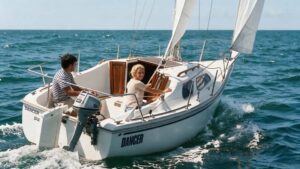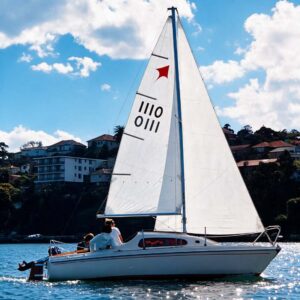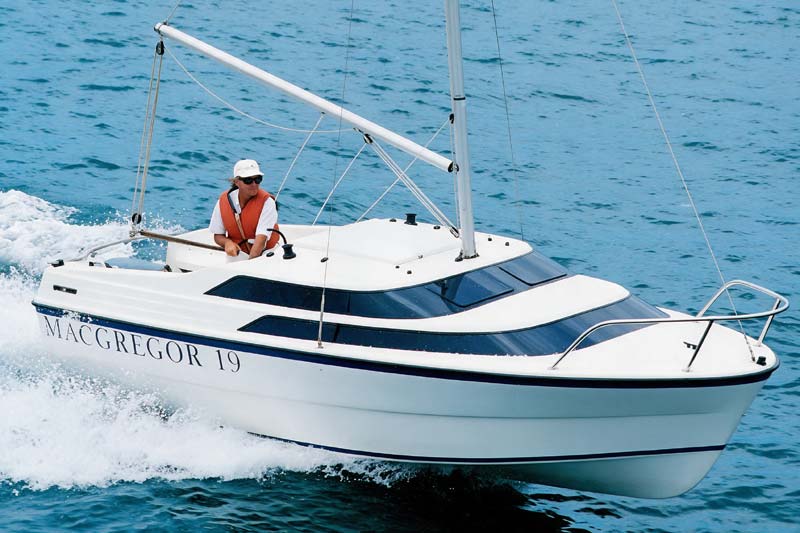
The tension between powerboat enthusiasts and sailors has existed for as long as motors have been placed on boats. Their priorities are naturally opposed, as powerboaters focus on reaching a destination quickly while sailors prioritize the journey itself. The American-built MacGregor 19 trailer sailer attempts to bridge this divide, offering the benefits of both styles. Equipped with a 40-horsepower outboard engine on the transom, it can reach speeds exceeding 20 knots while remaining a functional sailboat. According to importer Malcolm Douglas, the boat is designed for maximum enjoyment, allowing an owner to power out to a protected anchorage on a Friday evening, enjoy waterskiing the next morning, and go sailing when the afternoon breeze picks up.
A traditional trailer sailer in that same scenario would have to wait until Saturday morning to set sail, missing a night at anchor, whereas a powerboat might be forced to remain tethered to the shore if choppy waters make for an uncomfortable ride. The vessel also provides a gentle learning curve for beginners, who can operate the motor until they feel comfortable before attempting to sail. However, creating a hybrid craft involves inherent design trade-offs. The MacGregor 19 is fundamentally a powerboat modified to sail rather than a sailboat engineered to power well. The hard chine hull and 17-degree deadrise balance speed with wave comfort under power, though this hull shape is less optimal for traditional sailing dynamics.
Choosing an engine depends on how the boat will be used. A 40hp motor enables speeds fast enough for water-skiing, but its extra weight hinders performance under sail. Conversely, an 8hp engine is light and suitable for sailing but robs the boat of its ability to plane. Owners can either interchange a large motor with a small auxiliary engine or choose a middle ground like a 20hp outboard, which provides planing ability without adding excessive weight while sailing. To address stability without permanently adding heavy weight, the design uses a water ballast system. Opening a gate valve at the transom allows 360kg of seawater to fill an internal cavity, making the boat self-righting. This water can be drained by opening the valve while under motor at around eight knots or when winching the boat onto its trailer, keeping the towing weight light.
An unballasted centreboard lowers to reduce leeway while sailing and retracts completely into the hull during motoring to minimize drag. The twin rudders, however, present more of a compromise. They are relatively small and stubby to avoid excessive force at high speeds, which dulls the steering feel under sail. Furthermore, lowering them requires stepping into thigh-deep water to push them down by hand and secure them with a bolt. Retracting the centreboard and rudders allows the boat to draw just 23cm of water, making beach landings easy.
To prevent high-speed engine vibration from shaking the rig while planning, the mast breaks down into two 3.8-meter sections that store inside the cabin along with the boom. The basic rig features three shrouds and two halyards, making it quick and easy to set up in about 10 minutes. The standard sail area covers 15.5 square meters, dominated by a fully-battened mainsail, with options for a larger genoa, a taller rig, or an asymmetric spinnaker on future models. Sail controls remain simple, using two small cabin-top winches for the jib and a light purchase setup for the mainsheet.
During testing on the Gold Coast Broadwater, the 40hp Yamaha engine brought the boat onto a plane smoothly with minimal bow rise, handling chop cleanly and making fast progress. When switched to a small auxiliary engine under sail, the hull tracked steadily through the water with good stability due to its pronounced chines, although the wide transom created water turbulence astern. Overall performance under sail is calm and predictable, though it benefits greatly from strong breezes or assistance from the engine.
Inside, the two-tiered cabin layout is surprisingly roomy and can accommodate a family of four for a weekend. A large double berth sits beneath the cockpit floor, and a second double berth fills the forward section. The enclosed head on the starboard side is quite compact and best suited for storage. The galley components, including an icebox, stove, and sink, are placed near the forward berth to maximize living space, though this requires moving bedding when preparing meals. Headroom is sufficient for sitting and can be expanded to 1.80m using the pop-top roof. The main cabin floor remains wide and flat because the centreboard housing is completely recessed. The cockpit accommodates three to four people while sailing and up to six under power, complete with high coamings for protection and storage lockers under the seats. Ultimately, the MacGregor 19 serves its dual role well, providing a versatile weekend cruiser for powerboaters and sailors alike (Rothfield, Mark).
SPECIFICATIONS
* Length Overall (LOA): 5.70 m
* Beam: 2.30 m
* Displacement: 566 kg
* Water Ballast: 362 kg
* Draft (Board Down): 1.54 m
* Draft (Board Up): 0.23 m
* Sail Area: 15.5 sq m
* Recommended Outboard Power: 8 to 25 hp (Tested up to 40 hp)
* Price (as tested): $26,450 AUD
Source: John Crawford Marine. “Macgregor 19” Trailer Sailer Library. Accessed October 30, 2026.
https://www.johncrawfordmarine.com.au/advice/trailer-sailer/macgregor-19
Photograph reproduced for identification and historical research purposes. Copyright remains with the original rights holder.
Quick tip: Keep in mind that trailer sailers can vary quite a bit, even within the same class. Take the RL28, for example: they might not all have outboard wells as designed. Some originally may have had inboard engines, and when those were removed, the owners swapped them for a standard outboard mounted on the stern.