
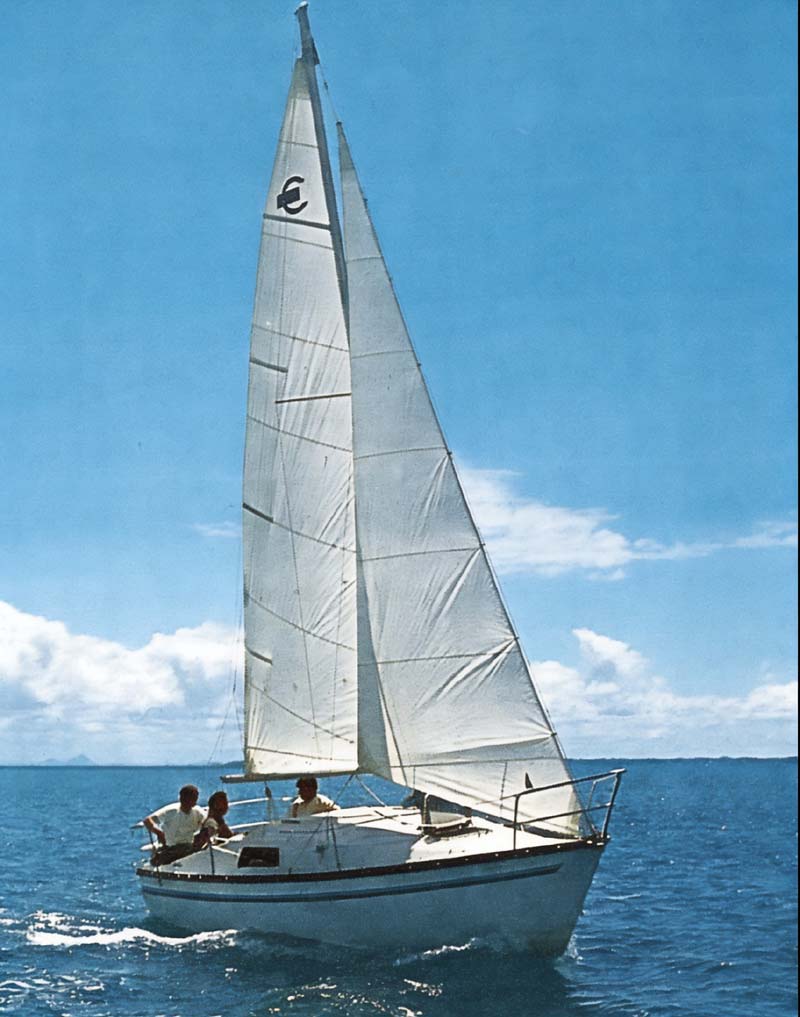
The Endeavour 23 Shoal Draft, designed by Reg Gardiner and built by Endeavour Yachts, is a rugged and seaworthy trailer yacht built in the style of the Aquarius 23. Constructed with a heavy-duty fibreglass hull consisting of four layers of chopped strand and two layers of woven glass, the boat features a conventional masthead rig and high-quality marine-grade stainless steel, bronze, and anodised aluminium deck fittings. Its unique design attempts to blend the convenience of a trailer sailer with the ocean-going stability of a deep keeler by utilizing a long, heavy, shallow-draft external keel that houses an internal swing centreboard. This arrangement keeps the heavy ballast below the floorboards, completely eliminating internal keel interference and leaving the cabin sole flat and unobstructed.
The primary trade-off for this enhanced stability and open floor plan is a more demanding launching and retrieval process compared to traditional, flat-bottomed trailer sailers. Because the fixed shoal keel draws 530mm even with the centreboard up, the yacht requires at least a couple of feet of water just to float clear of its custom roller trailer. Owners must be prepared to fully submerge the trailer, accept getting wet during the process, and perform regular maintenance on the wheel bearings, which are prone to sucking in cold salt water when hot. Furthermore, using a steep ramp is essential, as long, shallow boat ramps run the risk of floating the tow vehicle before the yacht can safely float off the trailer.
On the water, the Endeavour 23 SD delivers a secure, predictable performance that handles like a genuine keelboat rather than a skittish trailer sailer. It possesses proven JOG-type self-righting capabilities even with the fin in the up position, tracks beautifully through tacks, and remains remarkably stable during gibes without sliding or rocking. During testing on Moreton Bay, the boat proved to be stiff and highly stable, easily shrugging off gusts without excessive heeling. While it exhibited a slight lee helm in light breezes under a standard number one jib and mainsail, a trait that an overlapping genoa would likely correct, the hull performs exceptionally well to windward in heavy, hairy coastal conditions where lighter, planing trailer sailers like the RL24 or Timpenny might struggle.
The deck and cockpit layout focus heavily on safety and functionality. A deep, roomy, self-draining cockpit is separated from the main companionway by a high bridge deck that acts as a safeguard against flooding. The captain enjoys excellent all-round visibility over the flat, rigid cabintop, and the flat side decks make walking forward to the foredeck hatch and anchor well easy and secure. Headsail winches are placed within easy reach, and the mainsheet traveller is positioned at the front of the cockpit. Early testing on the prototype did reveal a few weak points, such as a fragile factory mast step and winch handle, which prompted the local builders to upgrade to much heavier, four-bolt rudder fittings through the transom.
Down below, the designer successfully managed to squeeze the basic layout of a 30-foot yacht into a 23-foot hull, creating a complete mini-yacht interior that can feel somewhat tight and enclosed. To open up the cabin and achieve 1.82 metres of standing headroom, the boat relies on a liftable pop-top roof. The interior is finished with a low-maintenance fibreglass furniture liner accented by teak trim. To starboard sits a compact galley unit, while the port side features a four-seater dinette that converts into a double bunk, with an icebox built into the space behind it under the cockpit seat. A child-size quarter berth provides additional accommodation on the starboard side aft.
A full-sized solid bulkhead separates the main saloon from the forward section of the boat to provide genuine internal privacy. Directly behind this bulkhead on the port side is a private toilet compartment complete with a washbasin vanity, balanced by a small hanging locker to the starboard side. The bow section contains a double V-berth with an overhead hatch for ventilation and light, though storage for extra wet sails remains limited. Priced at $5,480 for a basic assembly, approximately $10,741 for a standard sail-away package, and $12,264 (1979 prices) in full race trim, the Endeavour 23 SD represents a safe, strong, and highly capable bay and coastal cruiser that offers an appealing compromise for sailors seeking true keelboat manners in a trailable design (Hopkins 1979: 34-37).
ENDEAVOUR 23 SD
The yacht was built by Endeavour Yachts Pty Ltd, 51 Halstead St, Hurstville, NSW 2220 and was available in Queensland from The Yacht Spot, 117 Connaught Street, Sandgate, Qld. Designer: Reg Gardiner.
| Specification | Measurement |
| LOA: | 7.01m (23′) |
| LWL: | 5.8m |
| Beam: | 2.44m |
| Draft min: | 530mm |
| Draft max: | 1.3m |
| Displacement: | 1227kg |
| Ballast: | 409kg |
| Sail area: | 24.53sq m |
| Price: basic assembly | $5480 |
| Sail away: | $10,741 (approx) |
Hopkins, Paul (1979), ‘Endeavour SD23: Good enough for Captain Cook’, Seacraft, March, pp. 34-37, 84. Historical photograph reproduced for identification and historical research purposes. Copyright remains with the original rights holder.
Quick tip: Keep in mind that trailer sailers can vary quite a bit, even within the same class. Take the RL28, for example: they might not all have outboard wells as designed. Some originally may have had inboard engines, and when those were removed, the owners swapped them for a standard outboard mounted on the stern.