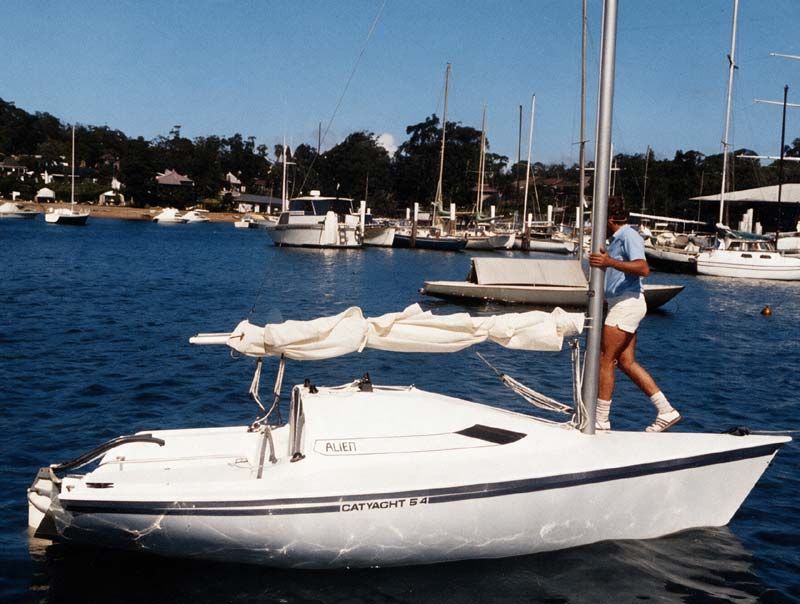
The Perth-designed Alien cat yacht represents a radical departure from conventional boat design that could reshape traditional attitudes toward sailing. Designed by John Swarbrick as part of his final naval architecture examination, for which he passed with honours, the Alien 6.4 is a light, fast, and stable trailer-sailer featuring an unstayed mast and several innovative design solutions. Swarbrick approached the vessel purely from engineering principles, translating mathematical calculations into resin and aluminium. Because cat-rigged vessels lack traditional stays, precise mast placement is crucial for both sailing performance and structural integrity. Built without relying on prior precedents beyond incorporating a broad beam carried well aft, the Alien features a flat-bottomed, round-sided skiff-like hull, an open transom, a split cockpit, and a compact cabin with sleeping space for four people.
A standout feature of the design is the centreboard arrangement. The board slides into a tapered case running through the cabin and utilizes a clever locking mechanism. Swarbrick repurposed a Teleflex cable, typically used for gear or throttle controls, to operate a heavy stainless steel bolt. Turning the hand control when the board is lowered slides the bolt over the top of the board to lock it securely in place. Raising the board requires a four-to-one purchase system, which can be routed to a winch if additional leverage is needed.
The cockpit is a significant piece of design work, and quite unlike anything ever seen. It is divided into two sections, with the sheet control on a traveller between the two sections. The inner cockpit is very deep and in fact its sole is bonded to the hull, at that point some 75mm thick. A large drain hole goes clear through the hull skin to take any water out. The cockpit sides are chained, so no matter what angle of heel you are on, you have real support, and such is the depth that a tall man has real leg room. The outer cockpit is open backed, in similar fashion to the Sonata 6.7 or any amount of racing dinghies.
Below deck, the interior is basic, offering a moulded liner with two settee berths and two quarter berths. The cabin space is divided by the centreboard case and lacks built-in flotation or tankage, making it spartan and best suited for short overnight stays rather than extended family cruising, though it provides adequate headroom and storage space.
The unstayed rig utilizes a custom extrusion designed by Swarbrick, measuring 107 mm at the base, which mounts onto a GRP tube running from the deck to the hull. Standard sail controls including the outhaul, cunningham, vang, halyard, and reefing lines lead back to the cockpit through turning blocks to jam cleats.
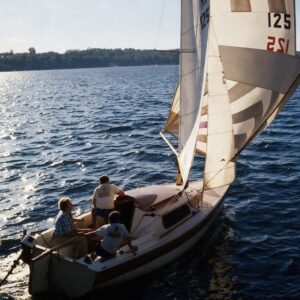
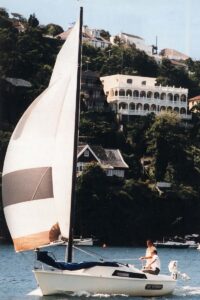
In performance testing, the Alien proved to be an exhilarating, stable, and highly manageable vessel. Sailing in 10 to 14 knots of wind, it pointed remarkably well upwind with a modest ten-degree heel, remaining predictable and responsive during gusts. Off the wind, the vessel accelerated rapidly, showcasing the planing potential of its flat-bottomed hull design. Handling remained smooth without unpredictable quirks, and the boat demonstrated excellent balance even in fresh breeze conditions.
Trailering and rigging the boat is simplified through clever engineering, with the unstayed mast weighing 29 kg. The vessel includes a specialized mast-raising tabernacle that clamps to the gunwales, enabling two people to easily erect or lower the rig in minutes. On the trailer, the mast sits in two cradles – one an extension of the win-ching post and the other through the hull! This is just wonderful, as the cradle goes down through the cockpit drain and slots over a pin welded into the trailer, effectively locking the boat to the trailer at the same time. So simple, so clever!
In his personal notes, designer John Swarbrick reflected on overcoming skepticism surrounding unstayed rigs and headsail-free designs. He noted that the vessel’s upwind performance exceeded initial expectations and expressed confidence in the viability of the cat-rigged concept. Swarbrick indicated that strong market interest could lead to future larger iterations, such as an eight-metre version or a quarter-ton style racer based on the same design philosophy (Davidson 1982, pp. 51-55).
Specifications:
* Boat Name: Alien (Catyacht 6.4)
* Designer: John Swarbrick N.A.
* Length Overall (LOA): 21′ 0″ (6.4 m)
* Beam: 8′ 2″ (2.49 m)
* Draft (Board up): 7″ (0.18 m)
* Draft (Board down): 4′ 2″ (1.27 m)
* Displacement / Weight: 1300 lbs (590 kg)
* Ballast: 181 kg (approx. 50 kg in board)
* Sail Area: 178 sq. ft. (16.5 sq. m)
* Price: $7,500 complete ex-Perth (at time of publication)
Source: Davidson, Mike (1982) ‘Alien 21’ Australian Boating, February, pp. 51-55.
Historical photograph reproduced for identification and historical research purposes. Copyright remains with the original rights holder.
Quick tip: Keep in mind that trailer sailers can vary quite a bit, even within the same class. Take the RL28, for example: they might not all have outboard wells as designed. Some originally may have had inboard engines, and when those were removed, the owners swapped them for a standard outboard mounted on the stern.