Towards the end of 1976, Sea-Craft conducted a test on a fully imported powerboat originating from New Zealand. The craft demonstrated such impressive quality and value that it raised the possibility of New Zealand manufacturers significantly impacting the Australian market if they chose to pursue it. While the Dancer trailer sailer is not a direct import, it draws heavy inspiration from Kiwi designs. Builder Barry McMurray made the decision to build the 5.85-metre (19 ft 2 in) boat after calculating that he could do so while keeping the project financially viable, identifying high quality as the essential factor for success. During the 1976 Sydney Boat Show, established yacht builders flatly informed McMurray that manufacturing the boat at his target price, just under $7,000 at the time was impossible, yet he successfully achieved and maintained this goal.
Upon inspecting the Dancer, the most immediate impression comes from the exceptional standard of its mouldings and overall finish. The fiberglass surfaces exhibit a brilliant sheen, and the gelcoat possesses a rich depth of colour that is typically seen only on select New Zealand craft. The vessel features a long, fine entry in its hull design, accompanied by adequate beam and a relatively deep transom. A key feature of its design is the drop keel mechanism, which relies on a mechanical screw thread system rather than traditional winches, cables, or webbing straps. The displacement of the boat is 860 kg (1895 lb), which includes 225 kg (495 lb) of lead ballast enclosed inside a fabricated steel keel, leaving no internal ballast inside the hull itself. The steering system utilizes a wooden dagger-blade rudder fitted into a fabricated alloy stock. Regarding the sail plan, the main sail covers 7.8 square metres (84 sq ft), the genoa provides 13.6 square metres (146 sq ft), and the No. 1 jib measures 9.3 square metres (100 sq ft).
Demonstration trips for boat reviews vary considerably in terms of organization and friendliness. Many boat builders appear frustrated by the requirement to demonstrate their vessels, making their displeasure obvious to reviewers. In contrast, Barry and Elizabeth McMurray provided an exceptionally well prepared experience, arriving early with a fully prepped boat, executing a smooth launch, and bringing along snacks and refreshments. This level of hospitality and efficiency was greatly appreciated by the testing team.
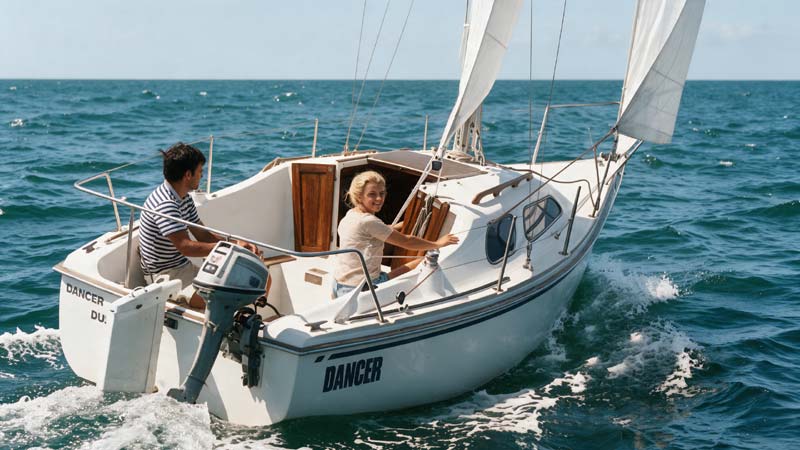
The craftsmanship remains the most striking aspect when viewing the boat on its trailer. Visually, the design achieves a sleek profile through a combination of low freeboard and an elegantly cambered coachroof. Running along the topsides is an attractive rub rail made of varnished wood fitted with a durable, replaceable insert along its leading edge. Leveraging his background as a former joiner, the builder executed the wooden detailing impeccably. Inside the cabin, the cream and brown hull is tastefully coordinated. In place of a standard fiberglass interior hull liner, McMurray applied a spray-on flocking finish using specialized machinery imported from Germany, showcasing an exceptional attention to detail.
Rigging the boat on its custom trailer was handled effortlessly by Barry and Elizabeth. The vessel was tested under power using a 7.5 hp Honda outboard, an engine gaining popularity as a high-torque auxiliary motor for small yachts, though its mounting bracket requires a bit of practice to reach easily. Initial cruising took place in calm early morning light without adjusting the traveller or sheet lead positions, resulting in the photographs showing the genoa sheeted somewhat too far aft.
As light winds picked up, the boat demonstrated responsive handling without requiring excessive effort. The main sheet is positioned over the bridge deck near the forward section of the cockpit, which also houses the winding mechanism for the keel. Storage is well thought out, including dedicated locker spaces and an ingenious tube arrangement for berths. For accommodation and amenities, the interior is equipped with a water tank, tables, and a gas stove.
In terms of cost considerations, trailer options range from standard single-axle units to tandem-axle models and a premium hot-dipped aluminium trailer offered by the builder. Including essential options like pulpits, lifelines, and a motor bracket, the complete package, inclusive of winches, interior trim, stove, water tank, rigging, and two sails, was offered at $6,950 at the time of testing, representing extraordinary value.
Minor criticisms encountered during the test were minor. The dagger rudder generated a slight rattle inside its alloy stock, though this could easily be dampened with a piece of felt. Additionally, the wide transom showed a slight tendency to drag, suggesting the boat benefits from careful fore-and-aft weight distribution. In terms of overall performance, the Dancer met expectations for a 19-foot trailer sailer, with its superior build quality and finish making it a stand-out choice in its class.
Specifications:
– Builder / Distributor: B.S. & B.E. McMurray
– Length Overall (LOA): 5.85 m (19′ 2″)
– Length Waterline (LWL): 5.05 m (16′ 6″)
– Beam: 2.35 m (7′ 7″)
– Beam Waterline (BWL): 2.00 m (6′ 6″)
– Displacement: 860 kg (1895 lb)
– Ballast: 225 kg (495 lb)
– Sail Area (Total): 21.4 m² (230 sq ft)
– Main Sail: 7.8 m² (84 sq ft)
– Genoa: 13.6 m² (146 sq ft)
– No. 1 Jib: 9.3 m² (100 sq ft)
– Storm Jib: 5.1 m² (55 sq ft)
– Spinnaker: 31.6 m² (340 sq ft)
– Mast Height: 7.5 m (24′ 6″)
– Price: Sailaway yacht (as tested) approximately $6,950; list price noted up to $10,500.00
Source: John Crawford Marine. “Dancer 19” Trailer Sailer Library. Accessed October 24, 2026.
https://www.johncrawfordmarine.com.au/advice/trailer-sailer/dancer-19
Photograph reproduced for identification and historical research purposes. Copyright remains with the original rights holder.
Quick tip: Keep in mind that trailer sailers can vary quite a bit, even within the same class. Take the RL28, for example: they might not all have outboard wells as designed. Some originally may have had inboard engines, and when those were removed, the owners swapped them for a standard outboard mounted on the stern.