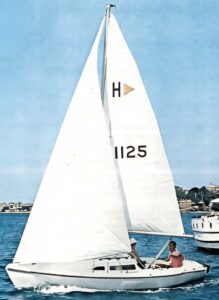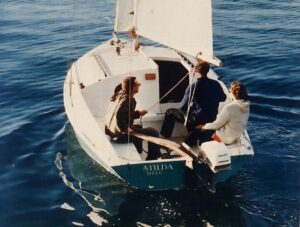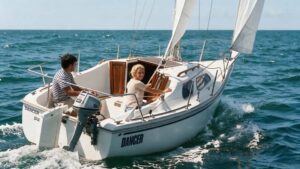
The Status 19 Cuddy is an ideal compromise for those who want to take up to seven or eight friends day sailing without owning a full-fledged Hobart racer. Designed by Van Der Stadt to be kept on a slip or mooring, the Status 19 was created to be fast, efficient, and fun.
Rigging the boat on the beach took about 10 minutes, though dragging it into the water required a few extra hands. During testing at Sydney’s Spit with north-easterly winds blowing 15 to 20 knots, the boat performed well, though it proved capable of carrying even more crew than the two testing it. Managing the Status 19 in those conditions was demanding, particularly since flying the spinnaker required both a skipper and two crew members.
While sailing, the testers noted several handling quirks. The headfoil worked smoothly, but the tiller extension (twiddle-stick) proved too short, restricting how far forward the skipper could move. Additionally, operating the mainsheet traveller from the deck proved awkward, as the snarl block kept catching and had to be kicked clear with a foot. The enormous cockpit offers room for about eight people, unusually spacious for a 19-foot boat, though sitting on the deck required swinging without solid support, suggesting a hinged or swinging toe-strap setup would be safer.
The forward cuddy cabin is very small, as are the side decks, both sacrificed to maximize cockpit size and passenger comfort. While small, the spray hood under the deck provides dry storage for clothes and gear, making the boat suitable as a family day-sailer. The large rudder is efficient, though raising or lowering its long dagger-type blade during beach landings proved difficult. The centreboard, controlled by a tackle block and lanyard, also suffered from excessive friction and required hard pulling to operate.
The hull measures 5.79 meters (19 feet) overall with a 2.24-meter (7 ft 3 in) beam, constructed entirely from glass-reinforced plastic (GRP). The cockpit floor is raised above the bottom of the hull over a wooden keelson and two polyurethane longitudinals, crossed by another beam at the mast to form separate watertight compartments. Self-draining cockpit vents and dual shock-cord-controlled drain flaps at the transom help clear water quickly if swamped. With a ballast ratio approaching 30 percent, the boat recovers easily when righted into the wind.
The rig features an alloy mast and boom supported by a single pair of shrouds and a forestay, with all halyards running internally. Mainsheet control uses a multi-purchase mid-boom sheeting system, though the testers noted the mainsheet jam cleat was impractical to operate by foot. The swinging keel mechanism proved effective, and the 15-square-meter sail area provided ample power in light to fresh breezes.
Overall, the testers praised the Status 19 as a great boat that offers strong value under $3,700 (1978), provided some minor deck hardware and rigging issues are addressed (Hopkins 1978, pp. 20-21).
Specifications
-
Length overall: 5.79 m (19 ft)
-
Beam: 2.21 m (7 ft 3 in)
-
Draft: 1.14 m (3 ft 9 in) board down; 0.152 m (6 in) board up
-
Weight: 400 kg
-
Ballast: 120 kg
-
Sail area (main): 17.3 m² (186 sq ft)
-
Spinnaker: 19.5 m² (210 sq ft)
-
Sailaway price: $3,705
-
Manufacturer: Status Yachts, 1 Lachlan St., Waterloo, NSW
Source: Hopkins, Paul (1978) ‘Lively Lady’ Seacraft, April, pp. 20-21.
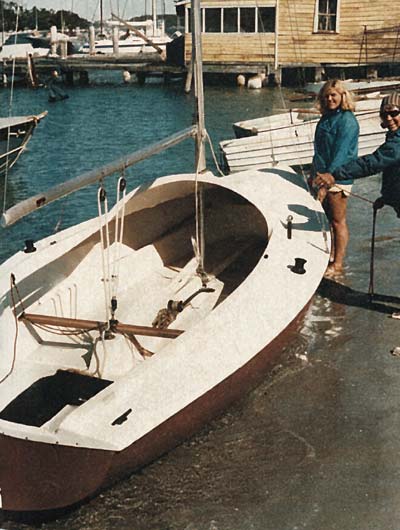
Historical photograph reproduced for identification and historical research purposes. Copyright remains with the original rights holder.
Quick tip: Keep in mind that trailer sailers can vary quite a bit, even within the same class. Take the RL28, for example: they might not all have outboard wells as designed. Some originally may have had inboard engines, and when those were removed, the owners swapped them for a standard outboard mounted on the stern.