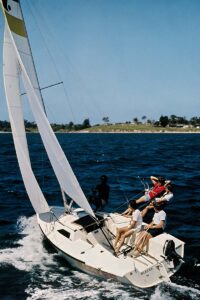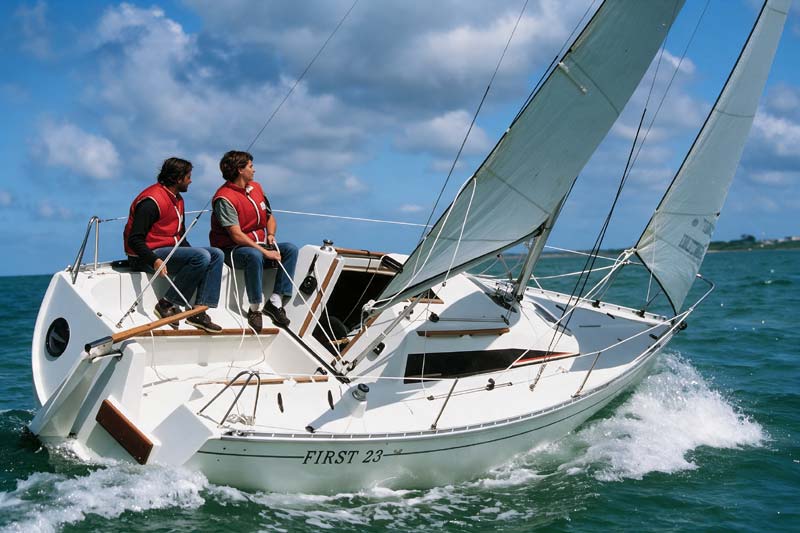
The common waterfront expression suggests that the ideal boat is always the next size up from what an owner currently possesses, a mindset that can leave sailors perpetually dissatisfied and longing for larger vessels. This perspective highlights the distinct advantages of smaller yachts, a category that has largely disappeared in Australia outside of trailer sailers. Small, affordable production yachts for beginners have become scarce in the local market, making the Beneteau First 235 a potential model for Australia’s boatbuilding industry. Designed by Groupe Finot, this vessel features a lean and active hull design characterized by a straight stem, a narrow waterline, and a wide beam that extends well toward the stern.
Although the modern trailer sailer originated in New Zealand with the Hartley TS16, French builders pioneered the design of lightweight, wide-beam small production yachts during the 1960s. Generating internal volume through a wide beam allowed designers to keep coachroofs low, creating a style of stock yacht that spread widely across France and enabled groups of sailors to cruise extensively along coastlines and around the Channel Islands in 23-foot boats. The First 235 directly inherits this concept and offers Australian buyers the choice between a fixed keel or a swing keel. The swing keel version utilizes a high-aspect pivoting blade operated by a locked worm-drive mechanism, which retracts beneath the cabin floor while leaving only a short 400mm stub near the table. Keel adjustment is handled by a socket drive on top of the case, accompanied by a sliding ball indicator that displays the current rake angle.
The hull measures 7.14 meters in overall length, with a hull length of 6.57 meters, a waterline length of 6.20 meters, a maximum beam of 2.50 meters, and a displacement of 1,200 kilograms. The fixed keel model carries 420 kilograms of ballast, whereas the lifting version carries 360 kilograms, drawing 1.15 meters and 1.75 meters respectively. When trimmed correctly, the forward knuckle rests right at the waterline, lifting clear when running to enhance directional stability while staying immersed at anchor to prevent irritating slapping sounds. Despite its modest size and priced just under $50,000 (at time of review), the boat demonstrates thoughtful design details, including angled cockpit coamings with teak heel strips, a short mainsheet track on the main bridgedeck, jammers for halyards, and a straightforward outboard mounting bracket on the transom.
The rudder uses a simple stainless steel bracket holding a fiberglass fin secured by nylon screws, and the transom top includes a rowlock fitting for manual sculling, though its open drainage hole leads directly onto the foot of the double quarter berth below. Inside, the cabin accommodates up to four people across the rear double berth and converted settee/vee berths around the lowered dining table. The port side houses an L-shaped galley equipped with a two-burner gas stove, sink, and icebox. To starboard, an ingenious layout provides an enclosed head that transforms into a chart table by lowering a timber seat over the toilet, positioning the navigator facing aft in an area with maximum headroom.
During water testing in winds ranging between 6 and 15 knots under a mainsail and number 3 jib, the First 235 proved well-balanced and responsive. It maintained lightness on the helm with one-finger steering and demonstrated solid stability as crew weight shifted to the gunwale. The boat reacted with the agility of a dinghy while retaining the composure and momentum of a larger yacht, showing quick grip from its deep keel after tacks and an eagerness to surf on swells. Overall, the boat serves as a versatile, low-maintenance cruiser/racer capable of mooring, trailing, or offshore sailing.
Specifications:
* Boat Model: Beneteau First 235
* Designer: Groupe Finot
* Builder: Beneteau, St-Hilaire-de-Riez
* Importer: Beneteau Yachts Australia (Sydney)
* Length Overall (LOA): 7.14 m
* Length Hull: 6.57 m
* Length Waterline (LWL): 6.20 m
* Beam (Max): 2.50 m
* Draft (Fixed Keel): 1.15 m
* Draft (Swing Keel): 1.75 m
* Displacement: 1200 kg
* Ballast (Fixed Keel): 420 kg
* Ballast (Swing Keel): 360 kg
* Mainsail Area: 14.40 sq m
* Working Jib Area: 7.60 sq m
* Spinnaker Area: 36.30 sq m
Source: John Crawford Marine. “Beneteau First 23.5” Trailer Sailer Library. Accessed October 21, 2026. https://www.johncrawfordmarine.com.au/advice/trailer-sailer/beneateau-first-235
Historical photograph reproduced for identification and historical research purposes. Copyright remains with the original rights holder.
Quick tip: Keep in mind that trailer sailers can vary quite a bit, even within the same class. Take the RL28, for example: they might not all have outboard wells as designed. Some originally may have had inboard engines, and when those were removed, the owners swapped them for a standard outboard mounted on the stern.