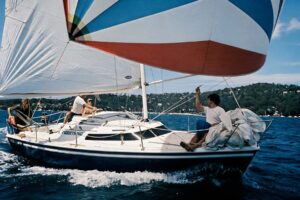
New Zealand boat designer Greg Elliott had made a strong impression across the Tasman over the years by creating a series of innovative yachts that deliver high performance without sacrificing ease of handling. While Australia’s conservative sailing market has been slower to adopt these designs, local sailors are recognizing Elliott’s talents. His recent achievements include the 17-metre mini maxi Rager placing fifth over the line in the Sydney-Hobart race, alongside other notable designs such as the Elliott 5.9, the trapeze-powered Gorilla Biscuits, and Transformer, which won the 1986 Auckland-Brisbane race. Elliott also creates versatile cruiser/racers, which are being imported to Australia through Trans Pacific Yachts and Cruisers.
The Elliott 7.4 is a smaller, trailerable version of his fast and spacious designs. The launch of the fibreglass production model experienced delays due to modifications made to the prototype. The local agents received their first production boat just three days before a major trailer sailer event, necessitating a rapid team effort by riggers, shipwrights, and sailmakers to get the boat ready. However, the initial test race suffered from dying winds, requiring a second test outing weeks later to properly evaluate the vessel’s capabilities.
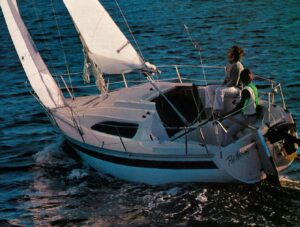
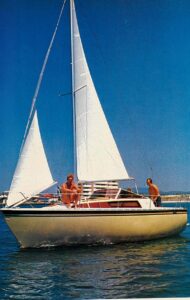
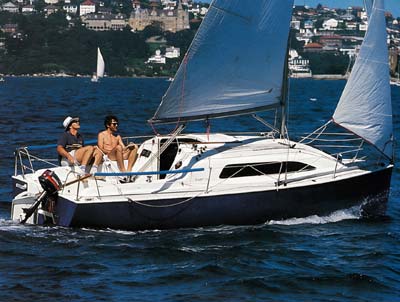
In terms of design, the Elliott 7.4 is larger and bulkier than many of Elliott’s previous creations. Weighing 1,000 kg with a 2.45 m beam, high freeboard, and full ends, it possesses substantial interior volume for its length. Features include a nearly vertical skiff-like bow with a rounded knuckle to reduce spray, a wide waterline, a broad transom, and full hull lines that maximize interior space. The yacht features a distinctive bulb keel fitted with large winglets that enhance effective draught and provide 410 kg of ballast at a 41 percent ballast-to-displacement ratio. Its centreboard is a narrow, high-aspect foil measuring 60 cm in width, housed in a centreboard box that serves as a footrest in the cabin and is operated by a hydraulic pump mounted on the cockpit coaming.
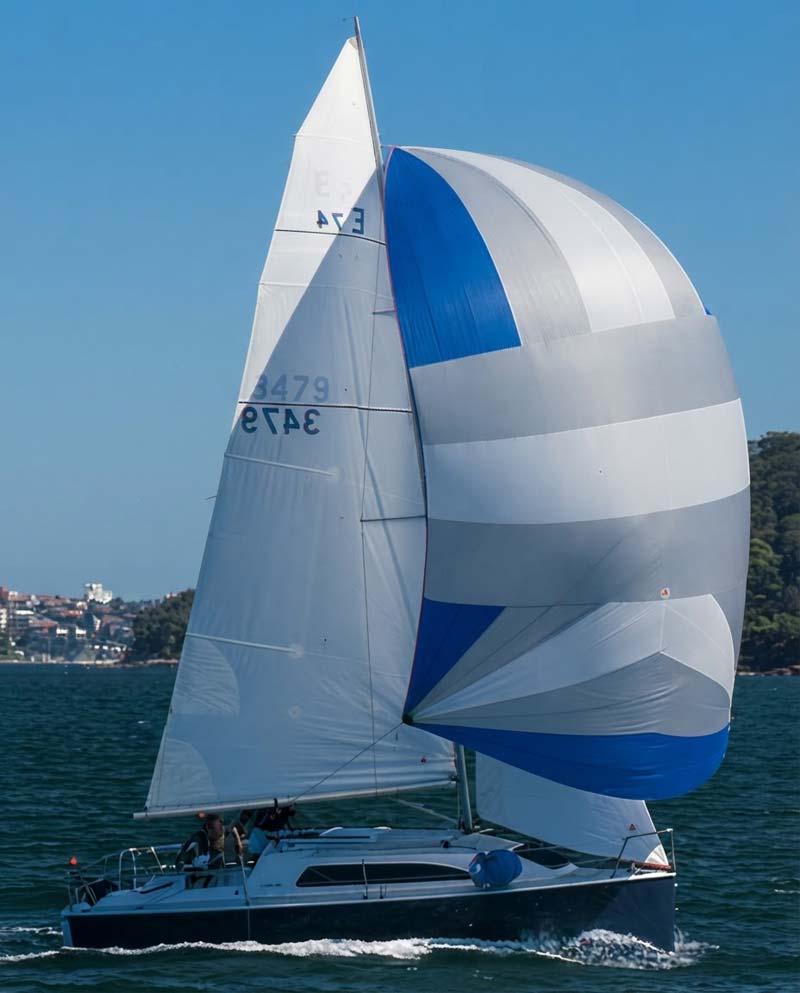
The deck layout is simple and functional, incorporating a shallow anchor locker forward, a high coachroof, and a broad, open-transomed cockpit with rounded coaming edges for comfortable seating. Deck hardware includes Barlow 16 winches for jib sheets and halyards, alongside an outboard motor mount on a lifting stern bracket. The sail plan features a large 22.28 square meter mainsail with a high roach supported by full battens, paired with a small 10 square meter overlapping headsail. The rig lacks a backstay and uses swept-back spreaders, making it straightforward to rig and adjust. A 44 square meter spinnaker provides downwind power, offering stability in heavy breezes though proving less efficient in light winds.
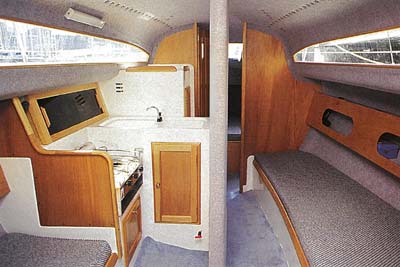
Below deck, the Elliott 7.4 feels remarkably large for a 25-footer, boasting 1.75 m of headroom in the main cabin and sitting headroom in the forecabin. Accommodations include two spacious quarter berths, a drop-leg saloon table, a settee berth, and a forecabin with space for two, separated by a kauri bulkhead and folding door. The gallery is located behind the centreboard case and features a two-burner Maxi stove with a grill, an icebox, a sink with a locker underneath, and dedicated storage. While spacious, galley counter space and hanging storage are somewhat limited. The test boat showed high-quality fibreglass mouldings and clean timber trim, featuring a combination of solid fibreglass and coremat deck construction.
On the water, the boat performs exceptionally well in medium to strong winds. In winds of 15 knots and above, the Elliott 7.4 sails upright, offering strong directional control, high stability, and impressive speed upwind and on a reach, reaching speeds up to 13.5 knots in gusts. Downwind performance under the large spinnaker is equally strong and manageable. However, the boat’s large wetted surface area and wide hull shape result in slower performance upwind in light winds under 10 knots. Subsequent tests in Victoria demonstrated that with proper sail tuning, performance in light breezes can be improved.
Overall, the Elliott 7.4 serves as an effective balance between cruising comfort and speed. It offers substantial interior room, stable handling, and high-speed potential, making it suitable for both competitive racing and family cruising.
Specifications:
* LOA: 7.4 m
* LWL: 6.6 m
* Beam: 2.45 m
* Draft: 165 cm – 81 cm
* Dry weight: 1000 kg
* Mainsail area: 22.28 m²
* Genoa area: 11.4 m²
* No 2 headsail area: 7.08 m²
* Designer: Greg Elliott
‘Elliott 7.4’ Australian Boating, 1988, February, pp. 31-34.
Historical photograph reproduced for identification and historical research purposes. Copyright remains with the original rights holder.
Quick tip: Keep in mind that trailer sailers can vary quite a bit, even within the same class. Take the RL28, for example: they might not all have outboard wells as designed. Some originally may have had inboard engines, and when those were removed, the owners swapped them for a standard outboard mounted on the stern.