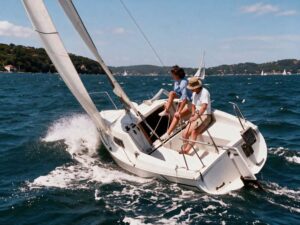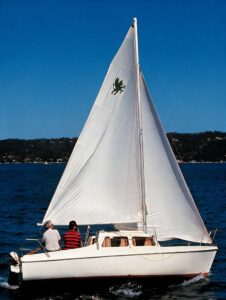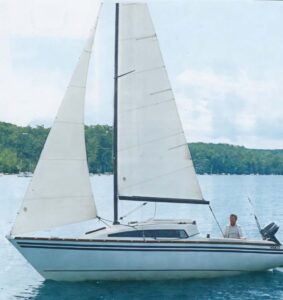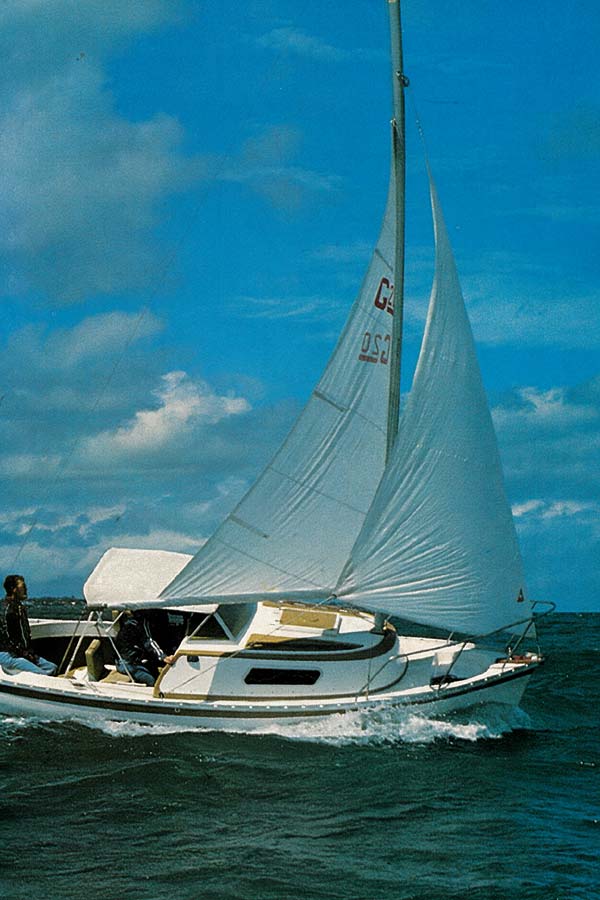
In the 70s, there was a growing concerns among Australian boaters regarding fuel conservation, escalating petrol costs, and the environmental impact of recreational boating. As fuel supplies tighten, the appeal of smaller, highly economical diesel-powered motor sailers and displacement cruisers becomes increasingly clear. Marine manufacturers like Maison Marine in Queenscliff have responded by offering models such as the Gilcraft 20 motor sailer and the Maison 630 (power only) displacement cruiser, both designed to maximize fuel efficiency while maintaining strong sea-keeping capabilities in challenging Australian coastal conditions.
During testing in Port Phillip amid a rising gale with winds reaching 30 to 35 knots, both vessels demonstrated distinct performance traits. The Maison 630, configured primarily as a displacement cruiser and powered by a 15-horsepower Yanmar diesel engine, handles roughly with significant spray at wide-open throttle around 3600 rpm, yet consumes minimal fuel at approximately 20 to 25 cents worth of diesel per hour. It relies on a long full-length false keel, though its steering requires careful management at lower idle speeds due to limited tracking stability without power. In contrast, the Gilcraft 20 features a round bilge and deep keel, offering smooth sea behavior and exceptional tracking. Under sail with its main and small storm jib, the Gilcraft 20 holds its line well against heavy seas, though it exhibits significant heel under strong gusts, which can be mitigated by taking on additional permanent ballast for mooring-based setups or by managing the sail area appropriately. Under power, the Gilcraft 20 is driven reliably by a 20-horsepower two-cylinder Bukh diesel engine, burning about three liters per hour at cruising speeds and roughly one liter per hour at idle, yielding a 24-hour continuous cruising endurance from its 70-liter fuel tank.
On deck and inside the cabin, both vessels offer practical, functional layouts tailored for light cruising or day trips. The Gilcraft 20 comes in three configurations ranging from an open fishing version to a fully appointed deluxe cruiser featuring cabin sleeping bunks, a private enclosed head, a compact galley, robust stainless steel bow rails, and a hinged aft cabin hatch to facilitate sail handling from the cockpit. The Maison 630 provides comparable interior volume with a slightly deeper bilge and seating arrangements, though both craft depend on manual hand pumps for clearing water rather than self-draining cockpits. Minor drawbacks noted on both models include under-spec’d plastic jib hanks on the Gilcraft, which are easily upgraded to brass or stainless steel, and side navigation lights that sit low or lack sufficient elevated mounting options for international road rules compliance. Ultimately, both craft exemplify low-cost, efficient boating solutions suitable for sheltered waters, bay cruising, and moderate offshore sailing (Andrews 1979, pp. 33-36).
SPECIFICATIONS (Gilcraft):
* Length Overall (LOA): 6.09 m (20 ft)
* Length Waterline (LWL): 5.75 m (18 ft 10 in)
* Beam: 2.48 m (8 ft 2 in)
* Draft: 0.66 m (2 ft 2 in)
* Ballast: 635 kg (1,400 lb)
* All-Up Weight: 1,360 kg (3,400 lb)
* Fuel Capacity: 70 liters
* Engine: 20 hp two-cylinder Bukh diesel
* Price as Tested: $15,580 (less trailer) (1979)
Source: Andrews, Graeme (1979) ‘Sail Report – Gilcraft 20 Motor Sailer: A Little Fuel Goes a Long Way’ Seacraft, July, p. 32.
Historical photograph reproduced for identification and historical research purposes. Copyright remains with the original rights holder.
Quick tip: Keep in mind that trailer sailers can vary quite a bit, even within the same class. Take the RL28, for example: they might not all have outboard wells as designed. Some originally may have had inboard engines, and when those were removed, the owners swapped them for a standard outboard mounted on the stern.