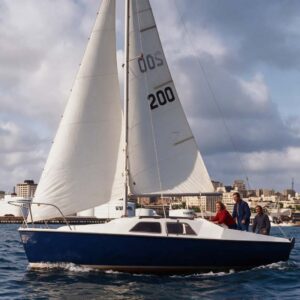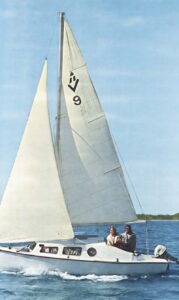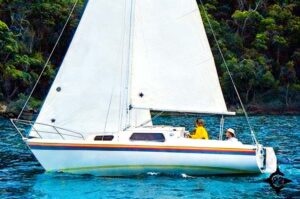
Writing a review for an exceptionally well-made product with few to no flaws can be challenging, and the Princess trailer sailer falls firmly into this category. Having earned an Australian Design Award from the Industrial Design Council of Australia, this boat proves to be a neat, economical, comfortable, and safe option for buyers looking to tow a compact yacht.
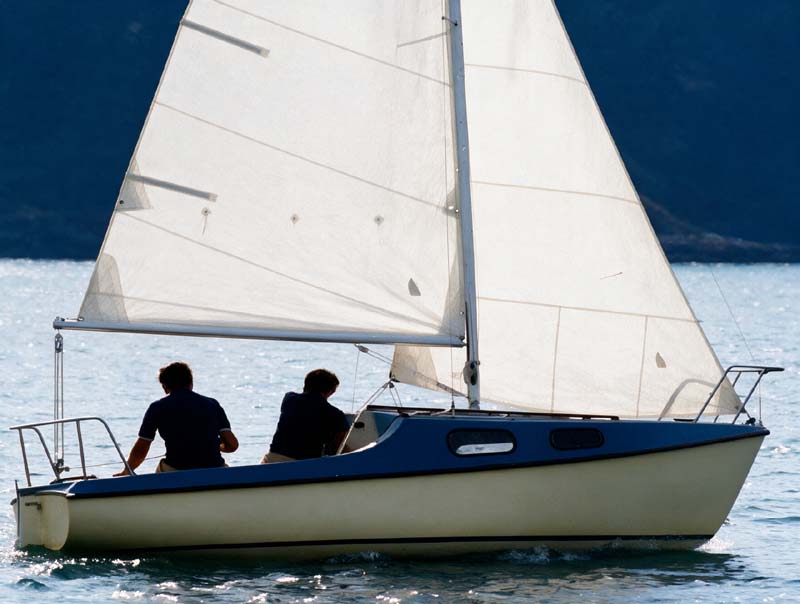
At first glance, the Princess resembles a scaled-down version of a Hood 23. Designer John Lucke acknowledged that the flush-deck cabin trunk concept was borrowed from Warwick Hood’s classic design. The objective was to create maximum internal volume and roominess in an 18-foot hull. Lucke set out to build a family yacht capable of sleeping four adults, housing a toilet and a functional galley suitable for week-long trips, and utilizing a simple rigging setup to avoid the complexities common in other small family boats.
Originally conceived as a 17-foot boat, the design was enlarged during development, culminating in an overall length of 18 feet 2 inches. Lucke built and sailed an initial timber version with his family for several months to refine the design before committing funds to create production molds.
The production boat features an overall length of 5.54 meters (18’2″), a waterline length of 4.87 meters (16′), a beam of 2.13 meters (7′), and a displacement weight of 498 kg (1,100 lbs). It includes 113 kg (250 lbs) of built-in ballast. A key feature is its twin fin keel arrangement, where two fins raise and lower inside centreboard-style trunk slots rather than a single central trunk. These fins are easily operated from the cockpit without needing complex hydraulic systems or tackles. By removing the traditional central centreboard case, Lucke eliminated a bulky obstruction inside the cabin while maintaining initial stability, directional tracking, and resistance to heel comparable to standard swing-keel or single-centreboard designs.
Regarding deck layout, the anchor setup on the review vessel was designed to be stowed under the outboard engine motor mount or well forward, though a permanently accessible foredeck anchor well would be a preferred configuration for sudden squalls. The flush deck features a smooth sliding hatch for main cabin access, and generous side windows allow plenty of natural light inside. The foredeck layout offers ample flat surface area for sunbathing.
During testing at Palm Beach, the vessel was set up without using the motor, sailing off and back to the moorings under light and fluctuating wind conditions. The boat demonstrated immediate responsiveness, steering easily and smoothly through light puffs.
The Princess handles variable wind conditions predictably. As gusts increase, the hull heels gently to a point before hardening up and resisting further heel, providing the crew ample time to adjust sheets or change seating positions without feeling sudden or severe lurching. Under heavier squalls, the yacht remains predictable and controllable.
The twin-fin setup performs well across all points of sail. While it may not point as high into the wind as some specialized racing or fin-keeled craft, the difference is minor for family cruising applications. Downwind and on a reach, performance is solid, and the lack of a central daggerboard trunk enhances living space without compromising handling.
Rigging the Princess for launching takes approximately 20 minutes for a single person, or around 10 minutes with two people working together. The mast setup utilizes a specialized knuckle fitting at the step, allowing the mast base to slide smoothly inside its casing without requiring extra pins, shackles, or heavy lifting efforts.
The forestay is equipped with a pelican hook to simplify rigging detachment, while the jib comes standard with roller furling, allowing it to be furled or deployed quickly. For trailering, the twin keels retract fully up into the hull, allowing the boat to sit low on its trailer like a standard displacement hull. The custom trailer uses a 5:1 winch system and minimal rollers to simplify launching and retrieval.
Aside from minor desires like an integrated foredeck anchor locker, the Princess stands out as a well-designed, well-built, and functional trailer sailer. It offers an impressive balance of cabin volume, comfort, stability, and ease of handling for small family cruising while requiring minimal maintenance and fitting easily into standard storage spaces.
‘Princess Trailer Sailer’ Australian Boating, April (1980), pp. 42.
Specifications:
-
Model: Princess trailer sailer
-
Construction: GRP (Glass Reinforced Plastic / Fiberglass)
-
Designer & Distributor: John Lucke, Padstow Heights, NSW
-
Key Feature: Unique twin fin design
-
Length Overall (LOA): 18 ft 2 in (5.54 m)
-
Waterline Length (LWL): 16 ft (4.87 m)
-
Beam: 7 ft (2.13 m)
-
Displacement: 1,100 lbs (498 kg)
-
Boards / Keel Weight: 150 lbs total boards; 250 lbs (113 kg) built-in ballast
-
Draft: 7 in (boards up) to 4 ft 5 in (boards down)
-
Sail Area:
-
Main: 107 sq ft
-
Jib: 50 sq ft
-
No. 1 Genoa: 75 sq ft
-
-
Accommodation: Sleeps 4 adults
-
Interior Facilities: Dinette, galley with sink, pump, icebox, stove, fitted toilet (standard), and standard foam flotation
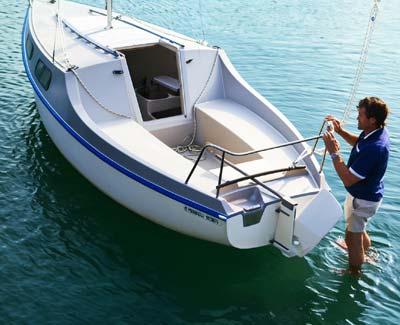
Historical photograph reproduced for identification and historical research purposes. Copyright remains with the original rights holder.
Quick tip: Keep in mind that trailer sailers can vary quite a bit, even within the same class. Take the RL28, for example: they might not all have outboard wells as designed. Some originally may have had inboard engines, and when those were removed, the owners swapped them for a standard outboard mounted on the stern.