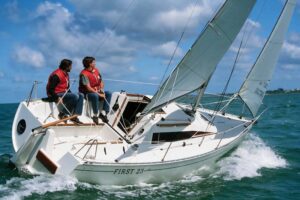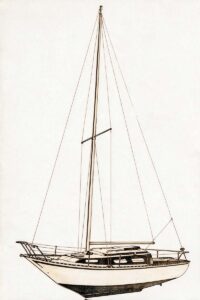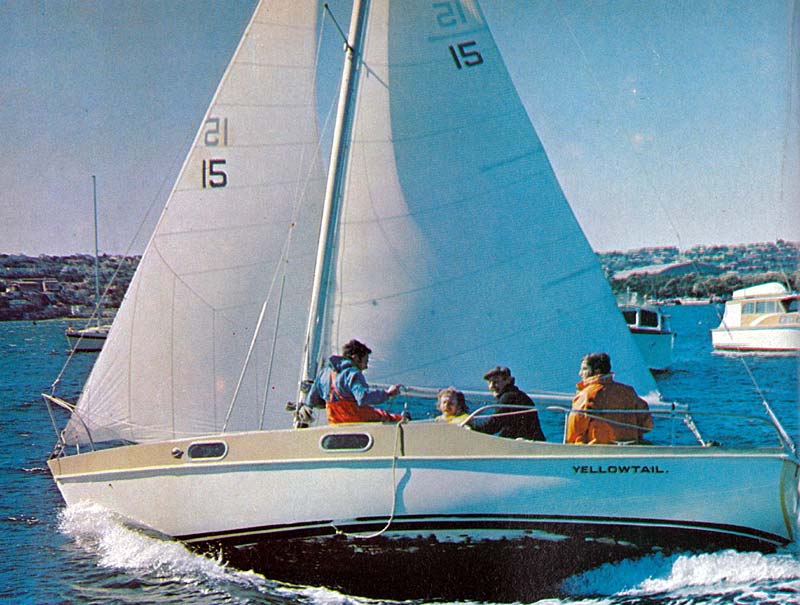
, ormer ocean-racing skipper and prominent businessman Graham Nock gets immense pleasure from his Hood 23 yacht, Yellowtail. He experiences excellent racing and comfortable family cruising for a tiny fraction of the cost of running a large vessel. Well-known Sydney yachtsman Graham Nock describes his Hood 23 Yellowtail as exciting, inexpensive, and effective. Yellowtail recently claimed the NSW State Hood 23 title with its owner-skipper Graham Nock, who previously owned numerous racing yachts, including the 13 m (43 ft) Cole flyer Rum Runner. Graham Nock, of the successful Nock & Kirby retail chain, is a typical busy executive with a growing family and a wide range of personal and business interests, including serving as president of the Retail Traders’ Association.
After a series of yachts ranging from Dragons to ocean racers, he found that the Hood is superb for racing, serves as a great day cruiser for the family, and costs one-tenth of the money and one-tenth of the time he used to spend on Rum Runner. Graduating from the inevitable V.J. skiff, he and his father, Sir Norman Nock, owned one of the first Dragons in Sydney Harbour. He later sailed the 11.5 m (38 ft) harbor racer Alysia before buying the beautiful Cole 43 Rum Runner, which he raced in major ocean events.
Graham’s school-aged children love sailing, but they also spend a lot of time training for competitive swimming and horse riding, keeping their horses at their Rosedale farm near Bathurst. The entire family finds the Hood ideal. They can swim, fish, and ride while still finding time to go sailing. Previously, Graham had to pay a hand to keep his vessel in shape at least two days a week on Rum Runner, but now he manages all the maintenance on the Hood himself with the aid of his sheet hand and co-skipper, Jimmy Black.
The cost difference is vast. Once, three Brookes & Gatehouse wind gauges on Rum Runner‘s mast were lost, costing him $400 each to replace. Today, Graham takes his sails home, hangs them on the clothesline to wash and dry, and simply steps aboard the boat at Rose Bay Pier whenever he wants to go sailing with all his gear. The gear is carried in two hands, and within 15 minutes they are ready for action. He demonstrated this by bustling around the boat, unhooking the cover, and quickly hoisting the mainsail. He was ready to sail in just 12 minutes.
He mentioned that he and his son can race the boat if necessary. Although they prefer a crew of four, especially when it blows, his son Jimmy brings his friends, making them already set for winter racing. In summer, they sail more seriously with the Royal clubs, accompanied regularly by David Goldberg and Jimmy Black. In addition to good racing and occasional Sunday picnics, Graham spends time taking his daughter to swim training, or visiting the farm on weekends. Previously, if he did not race Rum Runner, it was impossible to keep the crew together. Now, if Jimmy skippers Yellowtail when Graham cannot make it, or if Graham takes the family away to the farm, there is no issue.
Graham noted that he and his wife Pam, along with the girls, can handle her on Sundays for picnics, whereas Rum Runner required a crew of at least two others just for a day’s sail.
Yellowtail features simple, inexpensive, and effective fittings throughout. Built in fiberglass by C&L Fiberglass of Liverpool, there are around 200 in and around Sydney, several in Brisbane, and one recently won the Darwin to Dili (Portuguese Timor) race on handicap.
The total cost for a boat set up like Yellowtail comes to around $7,800 (spring 1974 pricing). Hood 23s race as a class with the Royal clubs on the main harbor in Sydney, and also with the Middle Harbour Yacht Club. Meanwhile, Rum Runner sets out on yet another tough ocean race, where outlay and upkeep are 10 times as high as for the little Hood 23 (Patrick 1974, pp. 22-25).
This review is the fixed keel version of the Hood 23 but the shoaldraft version is trailerable.
Specifications
-
Boat Model: Hood 23
-
Designer: Warwick Hood
-
Builder: Cal Fiberglass (Liverpool)
-
Hull Length: 7 meters (23 ft)
-
Waterline Length (LWL): 6.09 meters (20 ft)
-
Beam: 2.36 meters (7 ft 9 in)
-
Draft: 1.22 meters (4 ft)
-
Displacement: 1678 kg (3700 lb)
-
Sail Area: Main and headsail 30.56 m² (329 sq ft), plus a small spinnaker
-
Engine: Stowable in a special cockpit compartment, specifically an auxiliary Johnson Six
-
Accommodation: Sleeping for four and a small toilet below
-
Total Estimated Cost (circa 1974): Approximately $7000 complete with sails and outboard gear (consisting of $6050 for the hull, $816 for mainsail, $193 for genoa, $147 for spinnaker, $271 for spinnaker gear, $206 for a Johnson 6hp outboard, and $445 for gear)
SPECIFICATIONS – SHOALDRAFT
-
L-O-A: 7.31 m (23’7″)
-
L-W-L: 6.10 m (20’0″)
-
Beam: 2.35 m (7’9″)
-
Draft: .56 m (22″) & 1.30 m (4’3″)
-
Ballast (Lead): 635 kg (1400 lbs)
-
Displacement: 1292.75 kg (2850 lbs)
-
Sail Area: 27.87 sq m (300 sq ft)
Source: Patrick, Sheila (1974) ‘Magnate’s Favorite Yacht Cost $7000’ Seacraft, December, pp. 22-25.
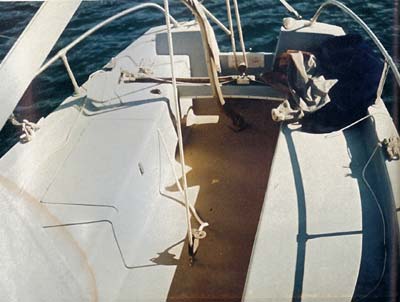
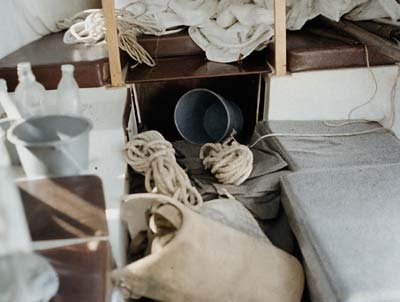
Historical photograph reproduced for identification and historical research purposes. Copyright remains with the original rights holder.
Quick tip: Keep in mind that trailer sailers can vary quite a bit, even within the same class. Take the RL28, for example: they might not all have outboard wells as designed. Some originally may have had inboard engines, and when those were removed, the owners swapped them for a standard outboard mounted on the stern.