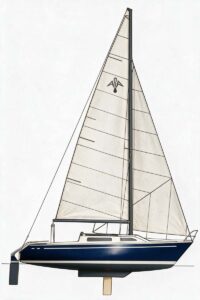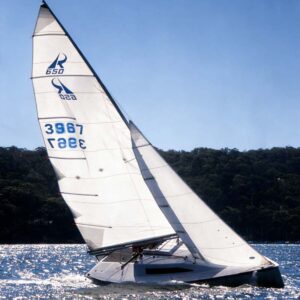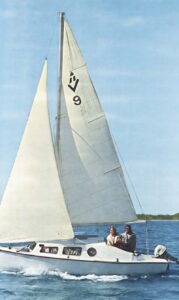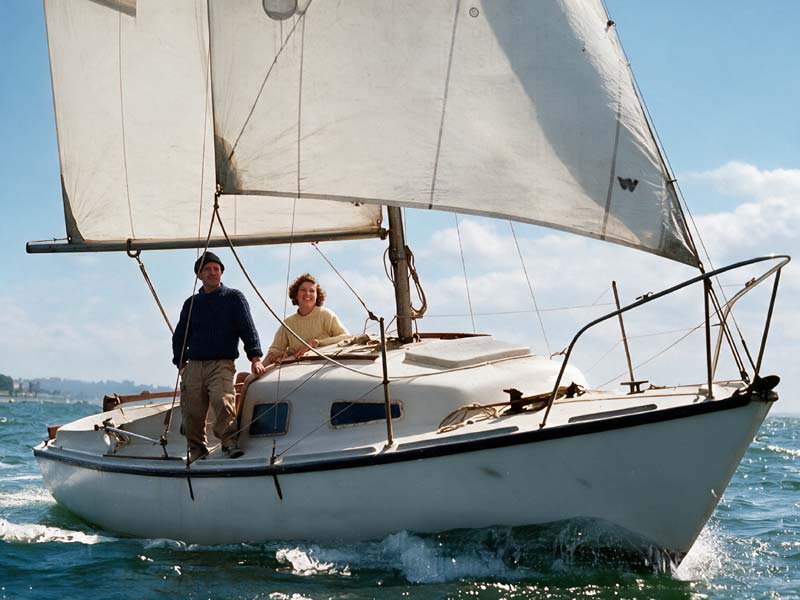
The Seal, designed by Angus Primrose and manufactured by John Baker (Kenton Forge) Limited, represents a departure from the typical mass-produced small sailing cruisers of its era. While most vessels of comparable length adhere to predictable hull shapes, rig choices, and interior arrangements, the Seal introduces an innovative design layout tailored specifically for day sailing and family recreation. At 21 feet 9 inches in length, it offers four berths, a small galley, and an optional marine toilet. Its most defining characteristic is an exceptionally spacious, split-level cockpit area comparable to that of a much larger racing yacht. This open concept is achieved by extending the coachroof only about three and a half feet past the mast and sweeping the cockpit opening forward, leaving the aft section of what would normally be an enclosed saloon open to the cockpit. The two levels are separated by a bridge deck carrying the mainsheet track. This configuration allows the crew to handle the vessel efficiently from the helm while enabling guests and children to relax safely in the sheltered lower section.
The vessel features a single, ballasted drop keel housed in a casing beneath the saloon table, reducing the draft from 3 feet 10 inches down to 2 feet. Paired with a lifting transom-hung rudder, this shallow draft allows the boat to be grounded comfortably or backed directly onto a shelving beach so passengers can step off onto dry land. Marine testing demonstrated superb handling and windward performance, easily maintaining speed and outperforming several larger production cruisers up to 25 feet during coastal and estuary sails.
Constructed from four primary glassfibre mouldings, comprising the hull, deck/cockpit, interior, and keel trunking, the hull exhibits a round bilge design with a broad 7-foot 9-inch beam, fine entry, and wide, flat sections aft. The interior moulding provides structural stiffening while forming the berth bases. Adequate interior headroom is maintained via a rounded coachroof without sacrificing the vessel’s sleek profile, although the sheerline forward appears slightly flat from certain front angles. The 800-pound drop keel is raised using a internal jack-screw mechanism operated by a folding handle on the keel casing. Thanks to heavy-duty plastic bearing blocks, the mechanism operates with low friction and requires minimal physical effort, even allowing a child to lift the ballast. A Perspex inspection window in the casing permits visual confirmation of the keel’s position. The galvanised steel lifting rudder blade is raised via a block and tackle system mounted on the tiller.
The interior accommodation includes a two-berth layout in the fore-cabin, with a middle cushion covering the optional marine toilet, though access to the chain locker beneath the berths lacks a deck pipe, occasionally allowing mud and water from the anchor line onto the cushions. The main bulkhead separates the fore-cabin from the saloon area, which houses full-length berths running to the bridge deck, open storage shelves, and a folding Formica table mounted above the keel trunking. Interior surfaces are finished with mahogany trim and a grey speckled paint over the unlined fibreglass. The open saloon area can be enclosed using one of three options: a canvas canopy that acts as a doghouse, a glassfibre hardtop, or a flat tonneau cover. The deep cockpit provides security for children and contains large side and aft storage lockers. However, the lack of internal partitions between the cockpit lockers and the main interior space means gear can shift unexpectedly, and engine fumes or gear smells can migrate into the sleeping cabin unless modified by the owner.
The foredeck offers a secure working platform equipped with a stemhead roller, fairleads, a chain pipe, and a bronze mooring cleat. Movement along the side decks to the bow is somewhat restricted by the wide cockpit opening, and the optional lifelines terminate near the main shrouds rather than running full length to the stern. The rig is a high-aspect-ratio three-quarter sloop setup on a deck-stepped Proctor alloy mast, supported by a forestay and aft-swept shrouds without a backstay. Auxiliary propulsion can be provided by 5hp or 6hp outboard motors mounted on a transom bracket, or by an optional 5hp inboard engine placed under the bridge deck.
From a nautical engineering perspective, as highlighted by technical analyses of the design, the boat’s rectangular, high-aspect-ratio drop keel and transom-hung rudder contribute significantly to its outstanding handling. The high-aspect-ratio rudder mounted far aft delivers maximum steering leverage with minimal drag and wetted surface area. This configuration minimizes the movement of the centre of pressure during turns, allowing the vessel to be steered effortlessly with small helm adjustments even in gusty winds, ensuring high windward efficiency and exceptional manoeuvrability.
Specifications:
* Designer: Angus Primrose
* Builder: John Baker (Kenton Forge) Ltd., Kenton, Exeter, Devon
* Length Overall (LOA): 21 ft 9 in (6.63 m)
* Length at Waterline (LWL): 18 ft 0 in (5.49 m)
* Beam: 7 ft 9 in (2.36 m)
* Displacement: 2,400 lbs (1,100 kg)
* Draft: Keel Up 2 ft 0 in (0.61 m) / Keel Down 3 ft 10 in (1.17 m)
* Hull Type: Round bilge with ballasted drop keel (800 lbs)
* Berths: 4 berths
* Sail Areas:
– Mainsail: 121 sq ft (11.3 m²)
– Cruising Genoa: 120 sq ft (11.2 m²)
– Working Jib: 63 sq ft (5.9 m²)
– Racing Genoa: 142 sq ft
– Spinnaker: 290 sq ft (27 m²)
* Auxiliary Engine Options: 5 hp Volvo Penta outboard, 6 hp Evinrude outboard, or 5 hp Brit inboard petrol engine with reversing propeller
* Pricing (1971):
– Basic Sail-Away Price: £1,307 (includes main, jib, deck fittings, anchor, pulpit, cushions, canopy)
– Base Model List Price: £1,145
– Canvas Canopy: £49.00
– Glassfibre Hardtop: £49.00
– Tonneau Cover: £24.20
– Bow Pulpit: £23.00
– Lifelines and Stanchions: £19.00
– Sheet Winches (pair): £23.00
– Flush Toilet: £49.00
Source: John Crawford Marine. “Seal 21” Trailer Sailer Library. Accessed November 4, 2026.
https://www.johncrawfordmarine.com.au/advice/trailer-sailer/seal
Photograph reproduced for identification and historical research purposes. Copyright remains with the original rights holder.
Quick tip: Keep in mind that trailer sailers can vary quite a bit, even within the same class. Take the RL28, for example: they might not all have outboard wells as designed. Some originally may have had inboard engines, and when those were removed, the owners swapped them for a standard outboard mounted on the stern.