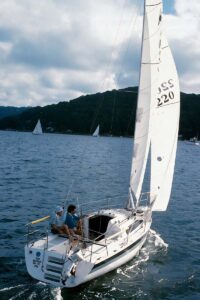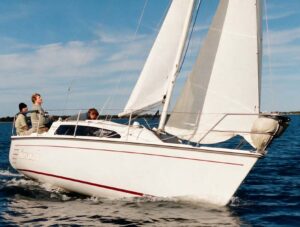
For nearly two decades, the Keough family operated Austral Yachts in South Australia, building a strong local reputation in the trailerable boat market. Their journey began with the Austral 20, a sturdy cruiser and racer that accommodated four adults and gained a loyal following at the Brighton & Seacliff Yacht Club as well as in long-distance trailerable events. Over time, Austral Yachts built 250 units of the Austral 20 while expanding their line-up under the direction of Adrian Keough alongside his wife Sue, daughter Patricia, and sons Michael, Geoffrey, and Scott. They went on to produce around 100 units of the Austral 24 and 30 units of the 30-foot model, both designed around family road-and-sea cruising with competitive performance capabilities.
Seeking to emphasize higher performance without sacrificing their signature interior accommodations, the Keough’s partnered with naval architect Scott Jutson to design a modern hull. Jutson crafted lines, a keel, and a rudder engineered for superior handling and performance while preserving the comfortable “mobile home” concept that trailer-sailer buyers expected. The resulting 8.25-meter Austral 8 Clubman featured a dinghy-like hull with fine entry fore sections, a relatively flat run, and a wide waterline beam aft to facilitate planing in strong breezes. Its firm turn at the bilge offered solid stability, while the U-shaped aft sections, inspired by recent International Measurement System designs, ensured balanced handling.
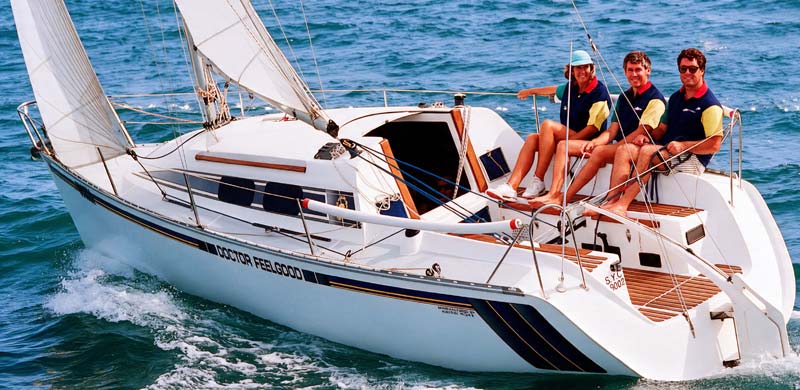
Austral Yachts built two initial models fully equipped with cruising amenities, including six berths, a galley, space for a head, full bunk cushions, and interior liners. When put to the test in racing conditions, their performance far exceeded initial expectations. A Clubman placed third over the line among trailerables in the Milang to Goolwa race during 10 to 15 knot winds and won the Thomas Hardy Memorial Trophy against a 150-boat fleet consisting mostly of dinghies like Sharpies, 505s, and Flying Dutchmen. At the National Trailable Championships on Lake Macquarie, Dr Feelgood placed fifth and Sailaway finished ninth in division one out of 45 entries, competing strongly against skiff-derived designs. Scott Jutson noted that the boat’s heavier, more powerful profile allowed it to make up significant ground upwind compared to lighter downwind-oriented boats, giving it a true yacht-like feel and excellent ergonomics that allowed a crew of five to manoeuvre effortlessly.
On-water testing in an 8 to 10 knot westerly breeze demonstrated excellent balance, high stiffness, and responsiveness even in light wind conditions under five knots. The cockpit ergonomics proved exceptionally comfortable, featuring recessed teak footrests in the seat corners and a well-designed layout for efficient sailing. Deck hardware and control arrangements were thoughtfully engineered, featuring a curved Harken traveller car, recessed deck fittings, and halyards and control lines run through under-deck tunnels to winches and jammers. The wide side decks offered clear access forward with non-skid surfaces, and flush-mounted fittings such as a recessed foredeck hatch, bow roller, and anchor locker prevented tripping hazards.
Additional design features highlighted the practical engineering of the vessel. The combined dagger rudder box and tiller unit included a pop-up safety device to prevent damage during groundings. The lead-loaded fiberglass lifting keel was operated via a six-part tackle system leading to a cabin top winch, allowing the boat to float in just nine inches of water when fully retracted, while its square top design ensured the fin could never drop out of the centreboard case. The high-aspect rig featured a tapered Baverstock mast with swept-back spreaders and a high boom. Furthermore, the outboard motor was ingeniously housed inside a dedicated, vented starboard cockpit locker rather than hanging awkwardly off the transom, with an option for a small inboard engine.
The hull construction utilized fiberglass and foam composite materials with Kevlar, E-glass, Divinycell, balsa cores, and vinylester resin to achieve a rigid, lightweight structure. An internal grid moulding bonded to the hull added structural strength while creating dedicated storage spaces and battery compartments. Four vacuum-bagged bulkheads provided structural integrity. Inside, the vessel was finished with vinyl headliners, carpeted topsides, ash-inlaid teak flooring, and teak trim. The layout featured a double V-berth forward, two settee berths in the main cabin, a foldable dining table, a navigation station with an integrated icebox, a double quarter-berth aft, and a galley with a sliding stove mechanism over the sink (Ross 1993, pp. 54-57).
SPECIFICATIONS
* Length overall: 8.25m
* Beam: 2.45m
* Displacement: 1200kg
* Ballast: 367kg
* Sail area: 32sq m
* Designer: Scott Jutson
* Builder: Austral Yachts, Hackham, SA 5163
* Pricing: $48,000 (1993) for the deluxe version (including stove, sink, and toilet); approximately $55,000 to $60,000 complete with sails, motor, and trailer
Source: Ross, Bob (1993) ‘Austral 8 Clubman’ Australian Sailing, June, pp. 54-57.
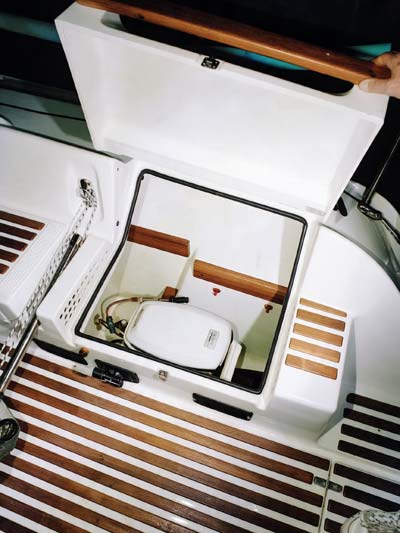
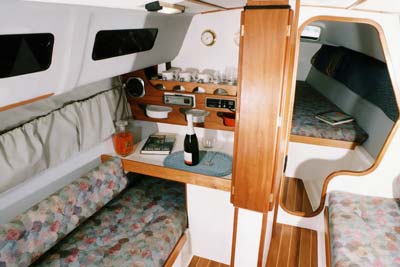
Historical photograph reproduced for identification and historical research purposes. Copyright remains with the original rights holder.
Quick tip: Keep in mind that trailer sailers can vary quite a bit, even within the same class. Take the RL28, for example: they might not all have outboard wells as designed. Some originally may have had inboard engines, and when those were removed, the owners swapped them for a standard outboard mounted on the stern.