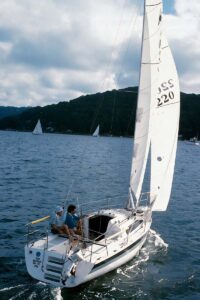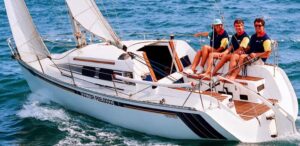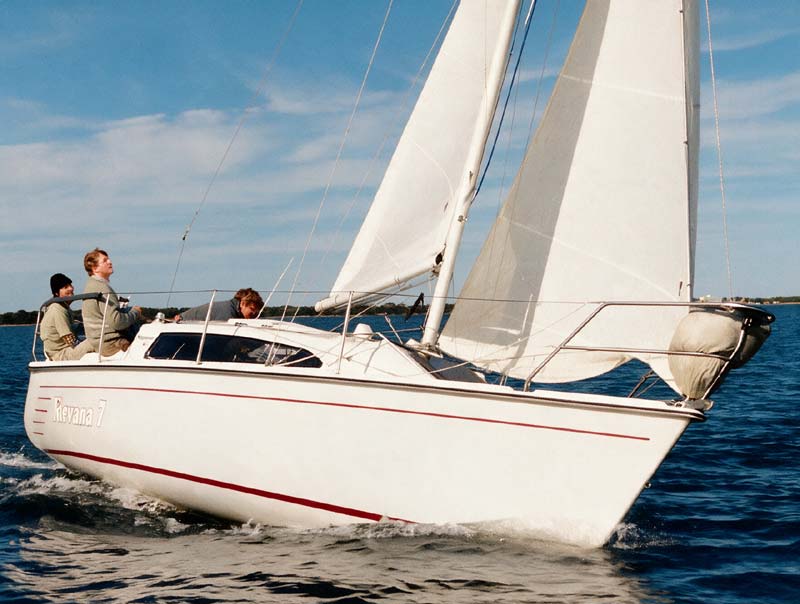
Developed four years prior by Rudi Waalkens at South Coast Yachts as a successor to the South Coast 22 and 25 models, the 28-foot design aimed to capture the market for large, versatile cruiser/racers at a reasonable cost. At the time of writing, production had been slowed by an economic downturn, but 68 boats had been built at a rate of roughly one per fortnight, with optimism for a return to regular monthly production.
In terms of performance, the Magnum 850 strikes a balance between extreme ultralight trailer sailers and comfortable cruising boats. Its lightweight displacement allows for easy towing while retaining generous internal room, standard full standing headroom throughout the cabin, high freeboard, and an enclosed head. Although four years old at the time of the review, the design remained competitive and up-to-date in market appeal, backed by established one-design class associations in New South Wales and Victoria that help maintain resale values and competitive racing standards.
On the water, tested aboard the privately owned Nirvana 7 on Lake Macquarie, the boat demonstrated predictable handling and good stability without feeling twitchy. In winds under 15 knots, options include a self-tacking headsail or a 15% genoa, achieving an upwind speed of around 5.8 knots. Downwind performance under a tri-radial spinnaker yielded speeds between 5.5 and 6.3 knots. The deck layout features halyards led back to cabin top winches (Barient 8s) paired with Spinlock rope clutches, allowing for efficient sail adjustments, reefing, or spinnaker hoisting.
The interior accommodations are spacious and practical for family cruising or two couples. The layout includes a double quarter berth to port, an L-shaped galley opposite with a hand pump, sink, icebox, two-burner stove, and teak-faced lockers. A central saloon features two settees, a bulkhead-mounted folding dining table that seats four to five people, a stowage bureau, a double vee berth in the forepeak, and a fully enclosed head to port. The boat’s construction uses a 12mm Divinycell high-density foam core sandwiched between woven fabric cloth and a protective chop-strand mat outer layer, supported by an interior structural sub-frame, 12mm ply bulkheads, and aluminium box channels around the centrecase.
Auxiliary power is provided by a 9.9hp Yamaha longshaft outboard mounted inside a dedicated cockpit locker with bomb-bay doors that seal flush when the engine is raised. Towing requires a capable four-wheel-drive vehicle, given the total trailable weight of approximately 2200kg including boat, trailer, fuel, and gear (Hill 1991, pp. 38-40).
Specifications:
* LOA: 8.5m
* LWL: 7.5m
* Beam: 2.45m
* Draft: 0.26m / 1.5m
* Dry weight: 1500kg
* Trailable weight: 2200kg
* Ballast: 500kg
* Main Sail Area: 18.5 sq m
* Genoa Sail Area: 17.8 sq m
* Jib Sail Area: 9.6 sq m
* Manufacturer: South Coast Yachts
* Pricing (1991):
– Basic structural boat: $26,915
– Sail-away kit: +$10,227
– Full factory fit-out: +$9,339
– Trailer: +$4,180
– Motor: ~$3,200
– As tested (with extras): $56,360
Source: Hill, James ‘Magnum 850’ Modern Boating, 1991, February, pp. 38-40.
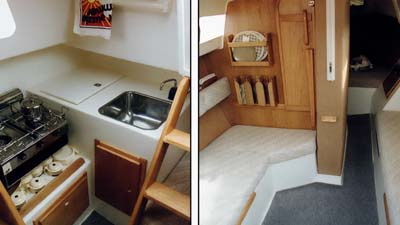
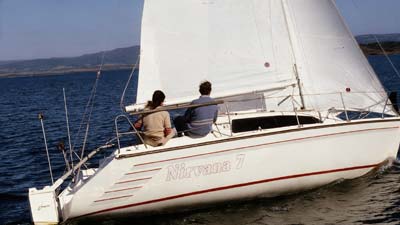
Historical photograph reproduced for identification and historical research purposes. Copyright remains with the original rights holder.
Quick tip: Keep in mind that trailer sailers can vary quite a bit, even within the same class. Take the RL28, for example: they might not all have outboard wells as designed. Some originally may have had inboard engines, and when those were removed, the owners swapped them for a standard outboard mounted on the stern.