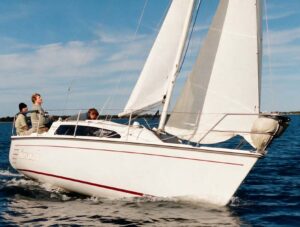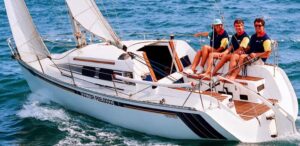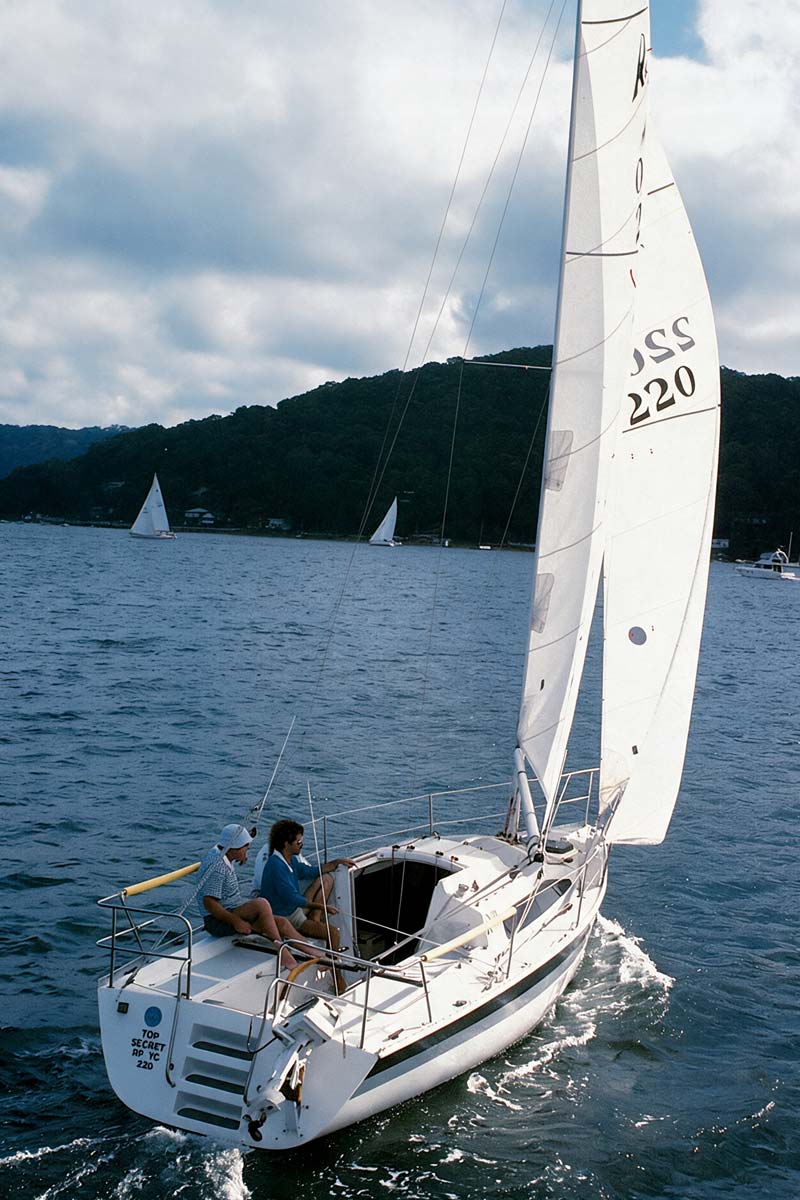
Designed by Murray Ross, a New Zealand naval architect known for radical light-displacement racers, the Ross 830 serves as an extended variant of the popular Ross 780 trailer yacht. Its defining characteristic is an exceptionally light displacement of 1,225 kg, rendering it considerably lighter than standard 8-meter boats like the Northshore 27 by more than a tonne and only slightly heavier than a J/24. The vessel features a narrow blade keel weighted by a 430 kg bottom bulb. While the standard design measures 2.6 meters in beam, slight modifications to the toe rails and hull lines allow it to fit within a 2.5-meter limit, making it legal for road trailering and trailer-yacht racing, complete with a lifting keel version that retains the same bulb and ballast configuration.
The hull design incorporates a fine entry with flattish U-sections at the bow, transitioning to a broad, flat stern featuring built-in boarding steps in the transom. Its high-aspect three-quarter rig carries a total sail area of 46 square meters. The mast is supported by swept-back spreaders, allowing it to remain securely standing without relying on running backstays. Although running backstays operated via cockpit-led tackles are present, they function solely as a rig-tuning mechanism for the forestay rather than primary structural support.
Internally, the Ross 830 features a layout designed to maximize functionality within its compact footprint. Positioned beneath the cockpit in the wide stern section is a double berth measuring 1.9 meters by 1.8 meters. Adjacent to the companionway on the port side is a galley equipped with an icebox, a single-burner methylated spirits stove, and a sink, offering 1.7 meters of headroom. Forward of the galley sits a small two-person settee opposite a longer settee berth, accompanied by a table that folds down from a half bulkhead. Behind this bulkhead lies an unusually spacious head compartment designed to accommodate a marine toilet, shower, and vanity with a sink, with the centreboard trunk integrated into the bulkhead structure on trailerable models. A V-berth occupies the forward section of the cabin. While this layout provides practical accommodations for family cruising, a traditional interior layout is also available as an alternative.
Construction of the Ross 830 was undertaken in Sydney by Kulmar, established builders of dinghies and skiffs. Hull construction utilizes a Termanto foam core sandwiched between an inner layer of bi-axial fiberglass cloth and an outer layer of chopped strand mat, complemented by a balsa-cored deck. Structural reinforcement for the keel is provided by a 9.5 mm steel plate moulded directly into the hull. Safety is enhanced through positive flotation incorporated beneath the double berths, enabling the vessel to remain afloat even if fully flooded due to hull damage or a knockdown.
On the water, the Ross 830 exhibits high speed performance across various conditions. Its US PHRF rating places it just behind performance designs such as the Young 88 and Noelex 30, competing closely with boats like the Spider 28 in line-honours racing. Light-air performance is strong both upwind and downwind, though achieving maximum speed and pointing ability requires careful sail trim. Downwind in heavy air, such as a 30-mile run in 20 knots of breeze, the hull planes easily, achieving speeds of 12 to 13 knots with good directional stability and control. Due to its light weight and substantial sail area, upwind performance requires active crew positioning on the rail and responsive rig adjustments. Overall, the boat provides a lively sailing experience suited for competitive sailors engaged in both inshore and short offshore racing.
Specifications:
* LOA: 8.3 m
* LWL: 7.2 m
* Draft: 1.5 m
* Beam: 2.6 m – 2.49 m
* Displacement: 1225 kg
* Ballast: 430 kg
* Mainsail area: 23 m²
* Genoa area: 23 m²
* Berths: 5
Source: ‘Ross 830’ Australian Boating, 1989, June, pp. 68-72.
Historical photograph reproduced for identification and historical research purposes. Copyright remains with the original rights holder.
Quick tip: Keep in mind that trailer sailers can vary quite a bit, even within the same class. Take the RL28, for example: they might not all have outboard wells as designed. Some originally may have had inboard engines, and when those were removed, the owners swapped them for a standard outboard mounted on the stern.